 How my food lives
Product
Fish: welfare and labels compared
Natural lifespan: Carp: up to 38 years (highest known age). In practice: Pond carp: 3 summers. Wild-caught and farmed. The questions apply to fish as well. How we read them is explained below. The scale counts only what a standard itself guarantees. Knospe and Naturland allow longer live transport than the law allows for journeys inside Switzerland, so on this question they can sit below the law. What the standard leaves open does not count. We list Naturland, but we have not checked whether it is sold in Swiss shops, so it does not count as the best organic offer.
Eight questions, eight answers
- How old are fish when they are killed for food?
Could live many years. Is slaughtered as soon as the fish reaches eating size. - Do farmed fish ever see their parents?
Usual: the young fish never see their parents. - How much space do farmed fish have?
The law prescribes no stocking density. - What does a farmed fish's habitat look like?
The law prescribes no structures. - Do farmed fish live outdoors?
The law prescribes no access to natural water. - What treatments do farmed fish get?
Routine treatments are not banned by the law. - How long are live fish transported?
Live fish may travel up to 10 hours at Knospe and Naturland. - How are fish killed?
Wild fish mostly die in air, on ice or when gutted. Farmed fish must be stunned.
Labels and standards at a glance
Level 1 is the lowest, the top level of the question is the best. A range such as 2-3 means our sources do not settle on one level. ? = no fixed rule.
Prices
| Standard | typical | range | What was priced |
|---|---|---|---|
| Wild-caught (no label) | CHF 49.00 per kg | salmon fillet, n=1, as of 21 Nov 2026 Migros (Wildlachsfilet mit Haut) | |
| ASC farmed salmon (Farm Standard or Salmon Standard v1.4) | CHF 61.40 per kg | CHF 53.50 to CHF 69.30 | salmon fillet, n=2, as of 21 Nov 2026 Coop (ASC Lachsfilet ohne Haut), Coop (Lachsrückenfilet ASC) |
| MSC wild catch (Fisheries Standard v3.1) | CHF 53.50 per kg | CHF 39.00 to CHF 68.00 | fish fillet, n=2, as of 21 Nov 2026 Coop (MSC Goldbuttfilet), Coop (Dorschrückenfilet MSC) |
Videos
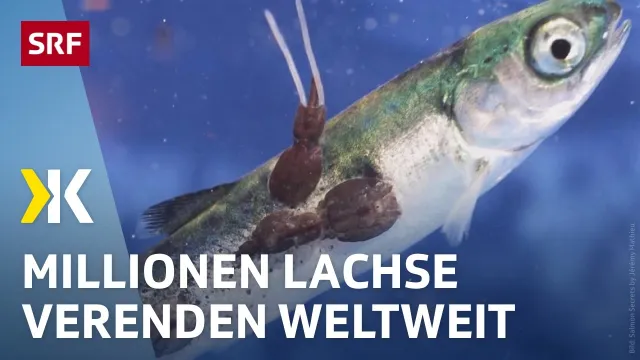 The suffering of salmon: mass deaths from disease in farmsSRF Kassensturz, 16 min
Kassensturz shows how farmed salmon became a mass product: about one in five fish dies early, and many are sick or infested with parasites.
 Aquaculture: what does fish farming in Switzerland look like?SRF Wissen (CO2ntrol), 6 min
Short interview with a ZHAW researcher on recirculating systems and the role of fish welfare in Swiss aquaculture.
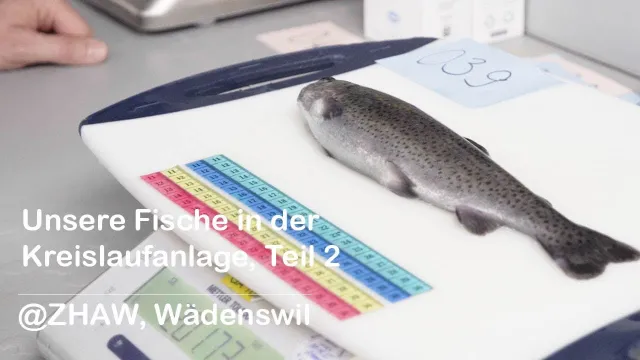 Our fish in the recirculating system (ZHAW Wädenswil)ZHAW, 2 min
Short look at a research project that films rainbow trout in a recirculating system to measure their welfare.
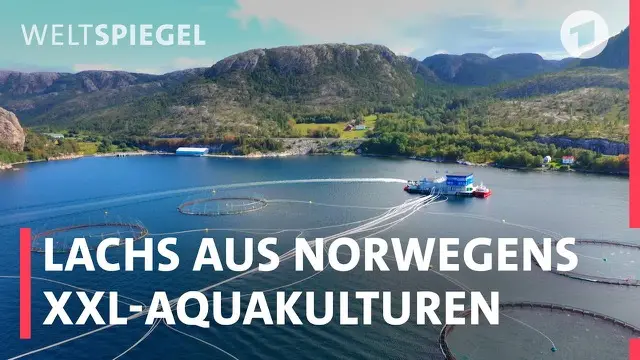 The tough business with salmonWeltspiegel (ARD), 29 min
Salmon farming in Norway: how the fish are kept and what problems arise.
Sources
- Animal Welfare Ordinance SR 455.1, as of 1 Feb 2026 (seen 21 Nov 2026)
- Animal Welfare Act SR 455, as of 1 Sep 2023 (seen 21 Nov 2026)
- Wild catch: the fish lives free in the sea, a lake or a river until it is caught (biology, no rule)
- James et al. 2025: Humane stunning or stun/killing in the slaughter of wild-caught finfish (Animal Welfare 34, e33, doi 10.1017/awf.2023.30)
- MSC Fisheries Standard v3.1
- Norway: aquaculture operations regulation FOR-2008-06-17-822, last amended FOR-2026-01-25-85 (§ 25 stocking density, § 31 interventions, § 34 stunning)
- ASC Farm Standard V1.0.1A2, August 2026
- Norway: Norwegian Veterinary Institute, Fiskehelserapporten 2024 (fish health report): salmon and rainbow trout first in fresh water on land, then at sea
- Norway: regulation on commercial transport of animals FOR-2012-02-08-139, last amended FOR-2023-05-09-678 (§ 2 scope, § 9 travel time; no maximum for fish)
- Bio Suisse standards 2026, part II (Knospe)
- Naturland standards for organic aquaculture 05/2026
- FishBase: common carp, highest reported age (38 years, ref. 72479)
- Proviande: the meat market at a glance 2025 (tables 11, 13, 14, 22, supply)