 How my food lives
Product
Eggs: welfare and labels compared
Natural lifespan: about 8 years, rarely 15 (estimate by Swissveg). In practice: about 18 months of age at slaughter (organic, over 80 weeks).
Eight questions, eight answers
- How long do laying hens live?
Could live several years. Is slaughtered after about a year and a half. - Do laying hens ever see their mother?
Every egg on sale, organic and free-range included, comes from a hen hatched in a hatchery. She never sees her mother. - How much space does a laying hen have?
A crowded barn with nests, perches and litter is usual. - Where do laying hens sleep and rest?
A perch at night and litter by day is usual. - How often are laying hens outside?
Daily pasture is usual under programmes with RAUS (Swiss programme for regular outdoor access), never in floor keeping. - Are laying hens' beaks trimmed?
A beak that may not be cut is usual. Beak tipping is allowed in the first two days of life. - How long are laying hens transported?
A drive of up to 6 hours is usual, the transport as a whole up to 8. - How are laying hens killed?
The law requires the spent hen to be stunned. Fear and stress beforehand are allowed, and no programme promises a death without fear.
Labels and standards at a glance
Level 1 is the lowest, the top level of the question is the best. A range such as 2-3 means our sources do not settle on one level. ? = no fixed rule.
Prices
| Standard | typical | range | What was priced |
|---|---|---|---|
| Barn eggs (legal minimum) | CHF 3.30 per 10 eggs | CHF 3.30 to CHF 4.30 | eggs, n=3, as of 21 Nov 2026 One of the three packs (Migros M-Budget) is imported; the Swiss Animal Welfare Ordinance does not apply to it. Coop (Schweizer Eier Bodenhaltung), Coop (Prix Garantie Bodenhaltung, 15 Stück), Migros (M-Budget Import Bodenhaltung, 15 Stück) |
| BTS and RAUS (Swiss federal programmes: animal-friendly housing and regular outdoor access; free range) | CHF 7.37 per 10 eggs | CHF 6.00 to CHF 8.73 | eggs, n=2, as of 21 Nov 2026 Coop (Prix Garantie Freilandeier CH, 6 Stück), Aldi Suisse (Regionale Freilandeier Ostschweiz, 4 Stück) |
| IP-SUISSE laying hens (BTS and RAUS, pasture) | CHF 5.25 per 10 eggs | eggs, n=1, as of 21 Nov 2026 At Migros, IP-SUISSE was sold as TerraSuisse from 2008; today the pack carries the IP-SUISSE ladybird. Migros (Eier 53+ Freilandhaltung, IP-SUISSE Qualität) | |
| Demeter (Switzerland) | CHF 11.58 per 10 eggs | eggs, n=1, as of 21 Nov 2026 Migros (Demeter Eier 53+, 6 Stück) | |
| Coop Naturafarm eggs | CHF 6.30 per 10 eggs | eggs, n=1, as of 21 Nov 2026 Coop (Naturafarm Eier Freiland 53g+) | |
| Knospe (Bio Suisse organic label, "the bud") | CHF 8.00 per 10 eggs | CHF 7.80 to CHF 8.20 | eggs, n=2, as of 21 Nov 2026 Coop Naturaplan organic carries the Knospe. Under the Migros organic guideline, Swiss Migros Bio comes from farms certified by Bio Suisse. Coop (Naturaplan Bio Eier Schweiz Freiland), Migros (Bio Eier 53+ Freilandhaltung) |
Videos
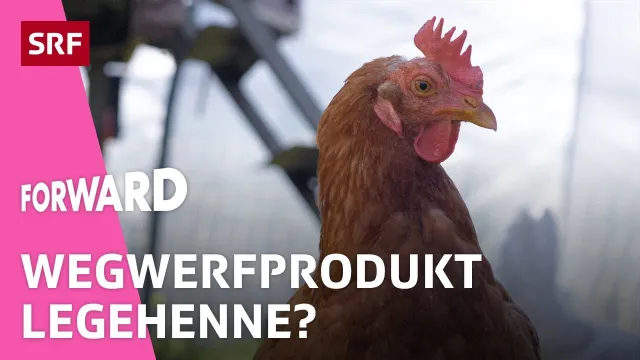 Mass product egg: why laying hens live a short lifeSRF Impact, 8 min
Short report from Switzerland: about two million healthy laying hens are killed every year. The film asks what potential is left in them.
Note: this video shows images some people find distressing.
End of chick culling: will we soon eat breakfast eggs with a clear conscience?SRF Wissen (Einstein), 35 minScience programme on the killing of male chicks in Switzerland and the ways to stop it: sexing in the egg and raising the brothers.
 FiBL Focus: livestock keeping, exploitation or fair deal?FiBL, 45 min
An animal scientist at FiBL explains why in his view species-appropriate keeping does not exist, and what that means for consumption.
 Frequently searched questions about factory farming and meat consumptionSRF Impact, 4 min
Four short answers to questions often searched online, for example whether there is an alternative to factory farming.
 How good is Swiss animal protection law really?Stiftung für das Tier im Recht, 22 min
Conversation with the foundation's director on the strengths and weaknesses of Swiss animal protection law.
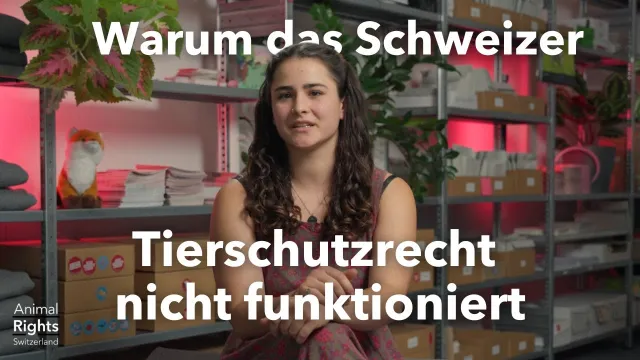 Why Swiss animal protection law does not workAnimal Rights Switzerland, 5 min
The organisation argues that the law mainly regulates the use of animals and gives examples of legal practices. This is the view of an animal rights group.
- Plant-based alternatives: kinds, shops, sources
- Label: Legal minimum
- Label: BTS and RAUS (federal programmes)
- Label: Organic under the Swiss ordinance
- Label: Knospe (Bio Suisse)
- Label: Demeter
- Label: KAGfreiland
- Label: IP-SUISSE
- Label: Coop Naturafarm
- Knospe (Bio Suisse) vs Organic under the Swiss ordinance: Eggs
- Knospe (Bio Suisse) vs Demeter: Eggs
- BTS and RAUS (federal programmes) vs Organic under the Swiss ordinance: Eggs
- Knospe (Bio Suisse) vs IP-SUISSE: Eggs
- KAGfreiland vs Knospe (Bio Suisse): Eggs
- Demeter vs Organic under the Swiss ordinance: Eggs
- Coop Naturafarm vs Knospe (Bio Suisse): Eggs
Sources
- Animal Welfare Ordinance SR 455.1, as of 1 Feb 2026 (seen 21 Nov 2026)
- Animal Welfare Act SR 455, as of 1 Sep 2023 (seen 21 Nov 2026)
- Direct Payments Ordinance SR 910.13, as of 1 Jan 2026 (seen 21 Nov 2026)
- Organic Farming Ordinance SR 910.18 (Fedlex)
- Bio Suisse standards 2026, part II (Knospe)
- Kontrolldienst STS: transport of large and small livestock, annex 1, valid from 1 Jul 2026 (2025 version compared: only the loading-gate sanction from 1 Jul 2027 is new, no change to travel time, duration or loading density)
- Demeter Switzerland standards 2026
- KAGfreiland animal husbandry guidelines 2026
- IP-SUISSE animal husbandry guidelines (as of March 2026)
- Coop Naturafarm eggs, guideline for pullet rearing and egg production, released September 2021 (archive copy of 2 Feb 2022)
- Bio Suisse / bioaktuell.ch: organic egg market overview 2025 (seen 21 Nov 2026)
- SRF Espresso: the end of chick killing from New Year (25 Nov 2025, seen 21 Nov 2026)