 How my food lives
Fish · Freedom of movement
How much space do farmed fish have?
The law prescribes no stocking density. Level at the front: 4 standards, among them Wild-caught (no label), MSC wild catch (Fisheries Standard v3.1) and Knospe carp (natural pond). Weakest: Legal minimum for farmed fish (Animal Welfare Ordinance, TSchV) and Knospe trout and salmon (tanks, net pens).
Why it is like this
Only suitable water quality is prescribed. Knospe allows 20 kilograms of fish per cubic metre, up to 30 with flowing water, and Naturland 10 for salmon and 20 for trout. At ASC the density is reported; we found no limit.
What the labels say
| Standard | Level |
|---|---|
| Legal minimum for farmed fish (Animal Welfare Ordinance, TSchV) | 1 Stand up and lie down again |
| Wild-caught (no label) | 4 Run and play |
| MSC wild catch (Fisheries Standard v3.1) | 4 Run and play |
| ASC farmed salmon (Farm Standard or Salmon Standard v1.4) | 2 Turn around and stretch out its whole body |
| Knospe trout and salmon (tanks, net pens) | 1-3 level 1 guaranteed (Stand up and lie down again); up to level 3 depending on the farm |
| Knospe carp (natural pond) | 4 Run and play |
| Naturland aquaculture trout and salmon (pond, net pens) | 3 Walk around without getting in anyone's way |
| Naturland aquaculture carp (pond) | 4 Run and play |
How we read the levels
- Stand up and lie down again.
- Turn around and stretch out its whole body.
- Walk around without getting in anyone's way.
- Run and play.
Level 1: Stand up and lie down again.
Applies to: Legal minimum for farmed fish (Animal Welfare Ordinance, TSchV) and Knospe trout and salmon (tanks, net pens)
The law prescribes no stocking density, only suitable water quality. At ASC the density is calculated and reported; we found no limit. For Knospe trout and salmon the exception for flowing water, up to 30 kg per cubic metre, counts.
Enclosures must have water quality that meets the needs of the species, with minimum values for the species in Annex 2 table 7 (Art. 98 TSchV). No density or structure is prescribed anywhere, and handling of the fish is to be limited to the unavoidable (Art. 99). ASC requires the stocking density to be calculated and reported (4.1.1.12); in a full-text search we found no upper limit. Knospe allows up to 30 kg per cubic metre in flow-through ponds and tanks if at most 100 kg of fish are kept per litre of inflow per second (5.7.11.2). Because this exception is open to part of the farms, the table shows Knospe trout and salmon at 1 to 3 and counts 1.
Level 2: Turn around and stretch out its whole body.
Applies to: ASC farmed salmon (Farm Standard or Salmon Standard v1.4)
Possible on some farms, not guaranteed: Knospe trout and salmon (tanks, net pens)
At most 25 kg of fish per cubic metre: that is how Norwegian law caps density for salmon in sea pens. It applies to ASC salmon from Norway, and ASC itself sets no lower limit.
The Norwegian aquaculture regulation caps the stocking density of salmon and rainbow trout in sea units at 25 kg per cubic metre, except slaughter pens and closed units (akvakulturdriftsforskriften § 25). The priced ASC salmon in this table comes from Norway according to its pack data (Open Food Facts, Coop ASC salmon fillet without skin). ASC requires the density to be calculated and reported (4.1.1.12), and we found no limit of its own. So the law of the country of origin counts. Swiss law does not apply to salmon from Norway.
Level 3: Walk around without getting in anyone's way.
Applies to: Naturland aquaculture trout and salmon (pond, net pens)
Possible on some farms, not guaranteed: Knospe trout and salmon (tanks, net pens)
Up to 20 kg of fish per cubic metre of water: Knospe allows 20 kg in tanks, up to 30 kg with flowing water, and 20 in net pens. Naturland allows at most 10 kg for salmon, 20 for trout, and 10 in net pens.
Knospe: 20 kg/m³ in ponds and tanks, up to 30 kg/m³ with flowing water if at most 100 kg of fish are kept per litre of inflow per second (5.7.11.2), and 20 kg/m³ in net pens (5.7.11.1). Naturland: salmon 10 kg, brook trout and whitefish 15, trout 20, net pens 10 kg/m³. At 10 kg per cubic metre the fish weigh one hundredth of the water. For Knospe, 3 is only the upper end, because flowing water allows up to 30 kg.
Level 4: Run and play.
Applies to: Wild-caught (no label), MSC wild catch (Fisheries Standard v3.1), Knospe carp (natural pond) and Naturland aquaculture carp (pond)
A wide natural pond in which at least half of the growth comes from natural food. That is the case for the Knospe and Naturland carp. For wild fish the step comes from biology: it lives free in the sea, a lake or a river until it is caught.
Knospe: stocking of at most 3,000 one-summer or 600 two-summer carp per hectare, at least 50 percent of the growth from natural food (5.7.11.3). Naturland: at most 1,200 kg of carp per hectare and year with supplementary feeding, also at least 50 percent natural food (Part B II 3.1). That the carp can "run and play" in the pond is our reading; no source says it. For wild fish without a label and with MSC the step comes from biology, not from a rule: the fish lives free until it is caught. MSC has no welfare rule and changes nothing here.
What stays open
There is no rule on this that we found. With wild catch the fish moves freely until it ends up in the net; that is our reading.
Videos
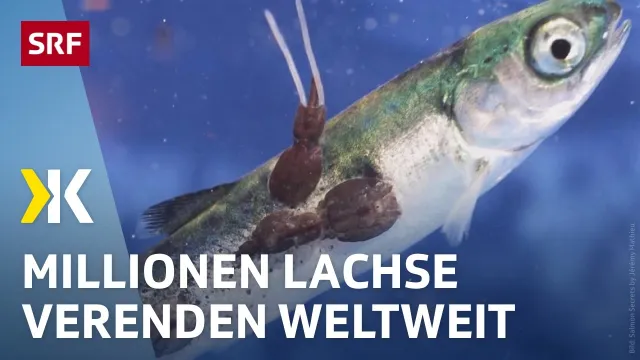 The suffering of salmon: mass deaths from disease in farmsSRF Kassensturz, 16 min
Kassensturz shows how farmed salmon became a mass product: about one in five fish dies early, and many are sick or infested with parasites.
 Aquaculture: what does fish farming in Switzerland look like?SRF Wissen (CO2ntrol), 6 min
Short interview with a ZHAW researcher on recirculating systems and the role of fish welfare in Swiss aquaculture.
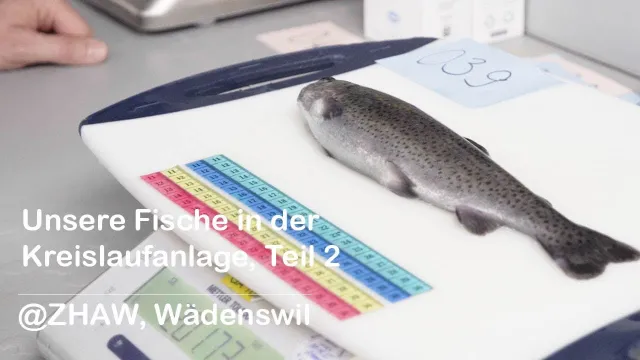 Our fish in the recirculating system (ZHAW Wädenswil)ZHAW, 2 min
Short look at a research project that films rainbow trout in a recirculating system to measure their welfare.
Sources
- Open Food Facts: Coop Qualité & Prix ASC salmon fillet without skin, origin Norway (entry 2114494014158, edited 2 Apr 2026)
- Wild catch: the fish lives free in the sea, a lake or a river until it is caught (biology, no rule)
- Animal Welfare Ordinance SR 455.1, as of 1 Feb 2026 (seen 21 Nov 2026)
- Norway: aquaculture operations regulation FOR-2008-06-17-822, last amended FOR-2026-01-25-85 (§ 25 stocking density, § 31 interventions, § 34 stunning)
- Bio Suisse standards 2026, part II (Knospe)
- Naturland standards for organic aquaculture 05/2026
- ASC Farm Standard V1.0.1A2, August 2026
- fair-fish, pages "Which labels?" and "Farming": no label guarantees good fish welfare (fair-fish.net)
- Everything on Fish
- How old are fish when they are killed for food?
- Do farmed fish ever see their parents?
- What does a farmed fish's habitat look like?
- Do farmed fish live outdoors?
- What treatments do farmed fish get?
- How long are live fish transported?
- How are fish killed?
- Label: Legal minimum
- Label: Wild fish without a label
- Label: MSC (wild fish)
- Label: ASC (farmed fish)
- Label: Knospe (Bio Suisse)
- Label: Naturland aquaculture