 How my food lives
Chicken · Freedom of movement
How much space does a broiler chicken have?
Up to 30 kilograms of animal per square metre is usual. Here the standards barely differ: 7 reach level 2.
Why it is like this
The Animal Welfare Ordinance allows 30 kilograms per square metre in units of more than 80 animals. At 2 kilograms live weight that is 15 chickens on a 1 by 1 metre patch. Knospe and Naturafarm stay at 20 to 25 kilograms.
What the labels say
| Standard | Level |
|---|---|
| Legal minimum (Animal Welfare Ordinance, TSchV) | 1-2 level 1 guaranteed (Stand up and lie down again); up to level 2 depending on the farm |
| BTS (Swiss federal programme for especially animal-friendly housing) | 1-2 level 1 guaranteed (Stand up and lie down again); up to level 2 depending on the farm |
| BTS and RAUS (Swiss federal programmes: animal-friendly housing and regular outdoor access; the standard of most labels) | 2 Turn around and stretch out its whole body |
| Organic under the Swiss Organic Farming Ordinance | 2 Turn around and stretch out its whole body |
| Knospe (Bio Suisse organic label, "the bud") | 2 Turn around and stretch out its whole body |
| Demeter (Switzerland) | 2 Turn around and stretch out its whole body |
| KAGfreiland | 2 Turn around and stretch out its whole body |
| IP-SUISSE meat chicken (BTS housing, slower-growing breed) | 1-2 level 1 guaranteed (Stand up and lie down again); up to level 2 depending on the farm |
| IP-SUISSE meat chicken with pasture | 2 Turn around and stretch out its whole body |
| Coop Naturafarm chicken | 2 Turn around and stretch out its whole body |
How we read the levels
- Stand up and lie down again.
- Turn around and stretch out its whole body.
- Walk around without getting in anyone's way.
- Run and play.
Level 1: Stand up and lie down again.
Applies to: Legal minimum (Animal Welfare Ordinance, TSchV), BTS (Swiss federal programme for especially animal-friendly housing) and IP-SUISSE meat chicken (BTS housing, slower-growing breed)
Under the legal minimum, BTS (Swiss programme for animal-friendly housing) and IP-SUISSE chicken without pasture, chickens stand close together at the end of the fattening. 30 kilograms of animal per square metre are allowed, which is 15 birds on a 1 by 1 metre patch at 2 kilograms each.
The Animal Welfare Ordinance sets at most 30 kg of stocking weight per square metre of walkable floor for fattening birds in units of more than 80 animals (annex 1, table 9-1). Smaller units get less: 25 kg for 41 to 80 animals, 20 kg for 21 to 40, 15 kg for up to 20. According to the EFSA summary (2023), footpad dermatitis increases at stocking densities above 11 kg/m². 30 kg/m² is almost three times that. Because 30 kg lies between 25 and 33 kg and these birds have no pasture, the table shows 1 to 2.
Level 2: Turn around and stretch out its whole body.
Applies to: BTS and RAUS (Swiss federal programmes: animal-friendly housing and regular outdoor access; the standard of most labels), Organic under the Swiss Organic Farming Ordinance, Knospe (Bio Suisse organic label, "the bud"), Demeter (Switzerland), KAGfreiland, IP-SUISSE meat chicken with pasture and Coop Naturafarm chicken
Possible on some farms, not guaranteed: Legal minimum (Animal Welfare Ordinance, TSchV), BTS (Swiss federal programme for especially animal-friendly housing) and IP-SUISSE meat chicken (BTS housing, slower-growing breed)
Under Knospe, Demeter, KAGfreiland and Coop Naturafarm the birds get somewhat more room. Knospe allows at most 20 kilograms per square metre in the barn, 25 with a countable outdoor climate area. The table reads the highest density allowed, so 25. Under BTS with RAUS, organic under the federal ordinance and IP-SUISSE with pasture, 30 kilograms per square metre are allowed in the barn, but from day 22 the birds have pasture every day.
Knospe, part II 5.5.6.4: in the final fattening at most 20 kg live weight per m² in the barn, up to 25 kg/m² with a countable outdoor climate area. Fattening poultry must have access to an outdoor climate area (5.5.6.8), so any farm whose area is counted may go up to 25 kg/m². We read the rung at this highest allowed density, 25 kg/m². KAGfreiland: the same figures in its stocking table (9.2: 20 kg LW/m², at most 25 kg LW/m² when the area is counted), flocks of at most 500 animals (9.1.1). Demeter sets no density of its own for broilers; for the rest Bio Suisse applies (4.9.4.7). Naturafarm Poulet gives 15 birds per m² at placement and a guide value of at most 25 kg/m² when 25 percent of the outdoor climate area is counted (4.3.1 F). Even 20 kg/m² is nearly double the 11 kg/m² above which EFSA reports more footpad dermatitis, and 25 kg/m² is more than double. At 20 kg/m² alone it would sit at rung 3, at 25 kg/m² it is rung 2. Placing it at rung 2 is our reading (not proven), because neither law nor label says how far an animal can actually walk. BTS with RAUS, organic under the federal ordinance and IP-SUISSE with pasture: in the barn the law applies, at most 30 kg/m² (Animal Welfare Ordinance annex 1, table 9-1). The organic ordinance gives no figure for poultry, only an appropriate stocking density (art. 16), but it requires RAUS (art. 15). RAUS requires access to pasture every day, from 1 pm at the latest to 4 pm at least and for at least five hours (Direct Payments Ordinance annex 6 B 4.1). The farm may restrict it only for snow, heavy rain, strong wind or very low temperature, with date and reason in the log (A 7.6, B 4.2, B 4.3). In the first 21 days of life the outdoor climate area is optional (A 7.7). IP-SUISSE requires pasture from day 22 (6.3.2). Our scale puts a density between 25 and 33 kg/m² at rung 2 when the same birds are sure to have pasture during the day, and at 1 to 2 without pasture.
Videos
 Meat chickens in Switzerland: the reality behind the welfare programmeStiftung für das Tier im Recht, 22 min
Conversation about the BTS welfare programme that almost all Swiss meat chickens are kept under, and what it means in the barn.
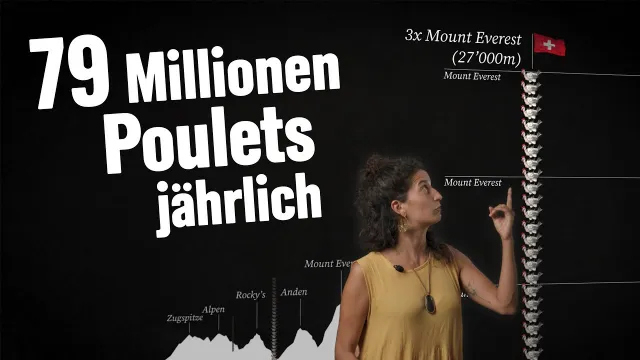 Ugly, brutal and short: the life of a meat chicken in SwitzerlandGreenpeace Schweiz, 9 min
The organisation shows how meat chickens are bred and kept in Switzerland and how short their lives are.
 Animal welfare and chicken meat: a look behind the barn doorsKAGfreiland, 77 min
Webinar with a KAGfreiland producer: how old meat chickens get and what a chicken barn looks like.
Sources
- Animal Welfare Ordinance SR 455.1, as of 1 Feb 2026 (seen 21 Nov 2026)
- EFSA 2023: welfare of broiler chickens, stocking density
- Bio Suisse standards 2026, part II (Knospe)
- KAGfreiland animal husbandry guidelines 2026
- Demeter Switzerland standards 2026
- Coop Naturafarm chicken, guideline for the Coop own brand Naturafarm Poulet, in force since 1 Jan 2024 (released January 2024)
- Organic Farming Ordinance SR 910.18 (Fedlex)
- Direct Payments Ordinance SR 910.13, as of 1 Jan 2026 (seen 21 Nov 2026)
- IP-SUISSE animal husbandry guidelines (as of March 2026)
- Everything on Chicken
- How long does a broiler chicken live?
- Do broiler chickens grow up with their mother?
- What do broiler chickens lie on in the barn?
- Do broiler chickens go outside?
- How long are broiler chickens transported to slaughter?
- How are broiler chickens killed?
- Label: Legal minimum
- Label: BTS and RAUS (federal programmes)
- Label: Organic under the Swiss ordinance
- Label: Knospe (Bio Suisse)
- Label: Demeter
- Label: KAGfreiland
- Label: IP-SUISSE
- Label: Coop Naturafarm
- Knospe (Bio Suisse) vs Organic under the Swiss ordinance: Chicken
- Knospe (Bio Suisse) vs Demeter: Chicken
- BTS and RAUS (federal programmes) vs Organic under the Swiss ordinance: Chicken
- Knospe (Bio Suisse) vs IP-SUISSE: Chicken