 How my food lives
Chicken · Lifespan
How long does a broiler chicken live?
Could live several years. Lives eight to nine weeks or less. The same for every label: Every broiler chicken (Mastpoulet) on sale is slaughtered young.
Why it is like this
A chicken can live about 8 years, rarely 15, according to an estimate by Swissveg; we have no expert source for it. A broiler is slaughtered after 56 to 63 days, organic after at least 81 days. The law names no minimum fattening time. In 2024 an average of 6.8 million broilers stood in Swiss barns; poultry meat consumption was 144,600 tonnes or 15.9 kilograms per person, of which 92,100 tonnes came from domestic production.
What the labels say
How we read the levels
- Until it is big enough to be used. It may still be very young.
- Until it is at least fully grown.
- Until it has lived half of its possible life.
- Until it is old.
- Until it dies of its own accord.
Level 1: Until it is big enough to be used. It may still be very young.
Every broiler chicken (Mastpoulet) on sale is slaughtered young. The law sets no minimum fattening time. Labels ask for 56 to 63 days, organic at least 81 days.
Federal payments set two limits: animals in the BTS (Swiss programme for animal-friendly housing) programme must be fattened for at least 30 days, in the RAUS (Swiss programme for regular outdoor access) programme for at least 56 days (Direct Payments Ordinance). The Animal Welfare Ordinance names no fattening time. The Swiss organic ordinance sets a minimum slaughter age of 81 days, otherwise slow-growing breeds must be used (art. 16g), Knospe at least 63 days at no more than 27.5 grams of gain a day, Coop Naturafarm 56 days. We have no expert source for how old a chicken can get: Swissveg estimates about 8 years, rarely 15 (an estimate from animal sanctuaries). A broiler lives only a small part of that. In 2024 an average of 6.8 million broilers stood in Swiss barns, against 5.1 million in 2014 (Agristat).
Videos
 Meat chickens in Switzerland: the reality behind the welfare programmeStiftung für das Tier im Recht, 22 min
Conversation about the BTS welfare programme that almost all Swiss meat chickens are kept under, and what it means in the barn.
 Ugly, brutal and short: the life of a meat chicken in SwitzerlandGreenpeace Schweiz, 9 min
The organisation shows how meat chickens are bred and kept in Switzerland and how short their lives are.
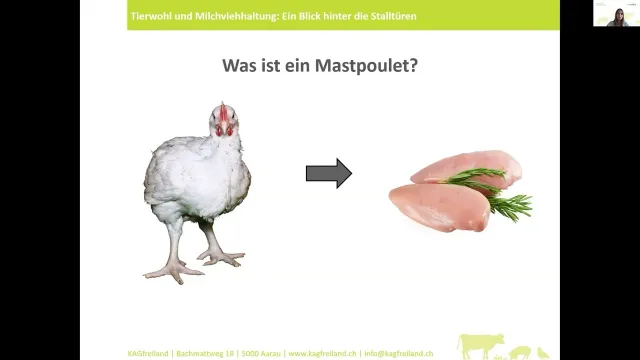 Animal welfare and chicken meat: a look behind the barn doorsKAGfreiland, 77 min
Webinar with a KAGfreiland producer: how old meat chickens get and what a chicken barn looks like.
Sources
- Direct Payments Ordinance SR 910.13, as of 1 Jan 2026 (seen 21 Nov 2026)
- Organic Farming Ordinance SR 910.18 (Fedlex)
- Bio Suisse standards 2026, part II (Knospe)
- Coop Naturafarm chicken, guideline for the Coop own brand Naturafarm Poulet, in force since 1 Jan 2024 (released January 2024)
- Agristat Aktuell 25-10: poultry meat consumption in Switzerland 2014 to 2024 (seen 21 Nov 2026)
- Animal Welfare Ordinance SR 455.1, as of 1 Feb 2026 (seen 21 Nov 2026)
- Demeter Switzerland standards 2026
- KAGfreiland animal husbandry guidelines 2026
- IP-SUISSE animal husbandry guidelines (as of March 2026)
- Everything on Chicken
- Do broiler chickens grow up with their mother?
- How much space does a broiler chicken have?
- What do broiler chickens lie on in the barn?
- Do broiler chickens go outside?
- How long are broiler chickens transported to slaughter?
- How are broiler chickens killed?
- Label: Legal minimum
- Label: BTS and RAUS (federal programmes)
- Label: Organic under the Swiss ordinance
- Label: Knospe (Bio Suisse)
- Label: Demeter
- Label: KAGfreiland
- Label: IP-SUISSE
- Label: Coop Naturafarm
- Knospe (Bio Suisse) vs Organic under the Swiss ordinance: Chicken
- Knospe (Bio Suisse) vs Demeter: Chicken
- BTS and RAUS (federal programmes) vs Organic under the Swiss ordinance: Chicken
- Knospe (Bio Suisse) vs IP-SUISSE: Chicken