 How my food lives
Chicken · Outdoors
Do broiler chickens go outside?
A barn with daylight is usual; under RAUS (Swiss programme for regular outdoor access) pasture only after the first weeks. Here the standards barely differ: 7 reach level 3.
Why it is like this
The law requires no outdoor access. BTS (Swiss programme for animal-friendly housing) requires a covered outdoor area, RAUS daily pasture from 1 to 4 pm. Under Knospe and Naturafarm pasture starts on day 22.
What the labels say
| Standard | Level |
|---|---|
| Legal minimum (Animal Welfare Ordinance, TSchV) | 1 Never. A bright barn is enough |
| BTS (Swiss federal programme for especially animal-friendly housing) | 2 Never, but it feels fresh air in the barn |
| BTS and RAUS (Swiss federal programmes: animal-friendly housing and regular outdoor access; the standard of most labels) | 3-4 level 3 guaranteed (On a few days a week); up to level 4 depending on the farm |
| Organic under the Swiss Organic Farming Ordinance | 3-4 level 3 guaranteed (On a few days a week); up to level 4 depending on the farm |
| Knospe (Bio Suisse organic label, "the bud") | 3-4 level 3 guaranteed (On a few days a week); up to level 4 depending on the farm |
| Demeter (Switzerland) | 3-4 level 3 guaranteed (On a few days a week); up to level 4 depending on the farm |
| KAGfreiland | 3-4 level 3 guaranteed (On a few days a week); up to level 4 depending on the farm |
| IP-SUISSE meat chicken (BTS housing, slower-growing breed) | 2 Never, but it feels fresh air in the barn |
| IP-SUISSE meat chicken with pasture | 3-4 level 3 guaranteed (On a few days a week); up to level 4 depending on the farm |
| Coop Naturafarm chicken | 3-4 level 3 guaranteed (On a few days a week); up to level 4 depending on the farm |
How we read the levels
- Never. A bright barn is enough.
- Never, but it feels fresh air in the barn.
- On a few days a week.
- On almost every day.
Level 1: Never. A bright barn is enough.
Applies to: Legal minimum (Animal Welfare Ordinance, TSchV)
Under the legal minimum a chicken never goes outside. The barn has daylight, so it is bright but closed.
The Animal Welfare Ordinance requires daylight in rooms where animals mainly stay (art. 33 para. 2). It does not require outdoor access for broilers.
Level 2: Never, but it feels fresh air in the barn.
Applies to: BTS (Swiss federal programme for especially animal-friendly housing) and IP-SUISSE meat chicken (BTS housing, slower-growing breed)
Under BTS (Swiss programme for animal-friendly housing) and IP-SUISSE Mastpoulet the birds get daytime access to a roofed outdoor climate area attached to the barn. They feel wind and fresh air but do not see open sky.
The BTS programme requires daytime access to the outdoor climate area (Direct Payments Ordinance, annex 6 A 7.1b). IP-SUISSE takes this over for the broiler without pasture (guideline 6.2). Pasture is not required here.
Level 3: On a few days a week.
Applies to: BTS and RAUS (Swiss federal programmes: animal-friendly housing and regular outdoor access; the standard of most labels), Organic under the Swiss Organic Farming Ordinance, Knospe (Bio Suisse organic label, "the bud"), Demeter (Switzerland), KAGfreiland, IP-SUISSE meat chicken with pasture and Coop Naturafarm chicken
Under BTS (Swiss programme for animal-friendly housing) with RAUS (Swiss programme for regular outdoor access), organic, Knospe, Demeter, KAGfreiland, IP-SUISSE with pasture and Naturafarm, chickens can also go out on pasture. That starts only after the first weeks, for Knospe and Naturafarm from day 22.
RAUS requires the outdoor climate area and pasture daily, pasture between 1 and 4 pm, at least 5 hours (Direct Payments Ordinance, annex 6 B 4.1). Knospe: outdoor climate area all day, pasture from day 22 for 75 percent of the day (part II 5.5.6.8 and 5.5.6.9). Naturafarm: open from day 22, 2 m² of pasture per bird. KAGfreiland: pasture for at least two thirds of life, daily (9.2.3). With a 63-day fattening, the days before day 22 are about a third of life (own calculation). A chicken sees the sky for only part of its life. Because daily access starts late in a short life, the table shows 3 to 4.
Videos
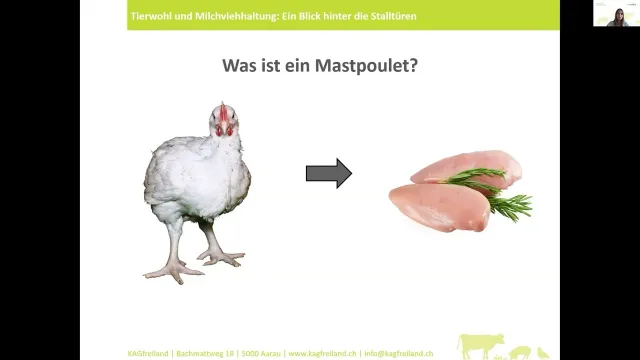 Animal welfare and chicken meat: a look behind the barn doorsKAGfreiland, 77 min
Webinar with a KAGfreiland producer: how old meat chickens get and what a chicken barn looks like.
 Livestock farming in Switzerland: where are the animals we eat?SRF Impact, 8 min
A reporter who looks after woolly pigs himself asks why we see so little of the pigs, cattle and chickens living in Switzerland.
Sources
- Animal Welfare Ordinance SR 455.1, as of 1 Feb 2026 (seen 21 Nov 2026)
- Direct Payments Ordinance SR 910.13, as of 1 Jan 2026 (seen 21 Nov 2026)
- IP-SUISSE animal husbandry guidelines (as of March 2026)
- Bio Suisse standards 2026, part II (Knospe)
- Coop Naturafarm chicken, guideline for the Coop own brand Naturafarm Poulet, in force since 1 Jan 2024 (released January 2024)
- KAGfreiland animal husbandry guidelines 2026
- Organic Farming Ordinance SR 910.18 (Fedlex)
- Demeter Switzerland standards 2026
- Everything on Chicken
- How long does a broiler chicken live?
- Do broiler chickens grow up with their mother?
- How much space does a broiler chicken have?
- What do broiler chickens lie on in the barn?
- How long are broiler chickens transported to slaughter?
- How are broiler chickens killed?
- Label: Legal minimum
- Label: BTS and RAUS (federal programmes)
- Label: Organic under the Swiss ordinance
- Label: Knospe (Bio Suisse)
- Label: Demeter
- Label: KAGfreiland
- Label: IP-SUISSE
- Label: Coop Naturafarm
- Knospe (Bio Suisse) vs Organic under the Swiss ordinance: Chicken
- Knospe (Bio Suisse) vs Demeter: Chicken
- BTS and RAUS (federal programmes) vs Organic under the Swiss ordinance: Chicken
- Knospe (Bio Suisse) vs IP-SUISSE: Chicken