 How my food lives
Dairy · Freedom of movement
How much room do dairy cows have?
The loose-housing barn is usual; in many barns the cow stands tied. Furthest along: BTS and RAUS (Swiss federal programmes: animal-friendly housing and regular outdoor access). Weakest: 6 standards, among them Legal minimum (Animal Welfare Ordinance, TSchV) and IP-SUISSE meadow milk.
Why it is like this
The law allows tethering with time outside on 60 days in the summer half-year and 30 days in the winter half-year. In 2020, 42.5 percent of dairy cow places were in tie stalls (BFS, via Proviande). BTS (Swiss programme for animal-friendly housing) requires group housing without tethering.
What the labels say
| Standard | Level |
|---|---|
| Legal minimum (Animal Welfare Ordinance, TSchV) | 1 Stand up and lie down again |
| BTS and RAUS (Swiss federal programmes: animal-friendly housing and regular outdoor access) | 3 Walk around without getting in anyone's way |
| IP-SUISSE meadow milk | 1 Stand up and lie down again |
| Organic under the Swiss Organic Farming Ordinance | 1 Stand up and lie down again |
| Knospe (Bio Suisse organic label, "the bud") | 1 Stand up and lie down again |
| Demeter (Switzerland) | 1 Stand up and lie down again |
| KAGfreiland | 1-3 level 1 guaranteed (Stand up and lie down again); up to level 3 depending on the farm |
How we read the levels
- Stand up and lie down again.
- Turn around and stretch out its whole body.
- Walk around without getting in anyone's way.
- Run and play.
Level 1: Stand up and lie down again.
Applies to: Legal minimum (Animal Welfare Ordinance, TSchV), IP-SUISSE meadow milk, Organic under the Swiss Organic Farming Ordinance, Knospe (Bio Suisse organic label, "the bud"), Demeter (Switzerland) and KAGfreiland
Under the legal minimum, organic, Knospe, Demeter and IP-SUISSE the cow may be kept tied, with time outside on some days. She can stand up and lie down but can hardly turn.
The Animal Welfare Ordinance allows tethering but requires time outdoors on at least 60 days from 1 May to 31 October and on 30 days from 1 November to 30 April. The animals may stay at most two weeks without a run (art. 40 para. 1). In 2020, 42.5 percent of dairy cow places were in tie stalls (BFS farm census 2020, via the Proviande dossier on animal keeping). Knospe and Demeter allow tethering with RAUS (part II 4.1.1.1, Demeter 4.9.4), IP-SUISSE requires RAUS only (5.5.1). KAGfreiland requires the loose-housing barn, with a permit possible for existing tie stalls (2.3). Because this exception is granted case by case, the table shows KAGfreiland at 1 to 3 and counts 1.
Level 3: Walk around without getting in anyone's way.
Applies to: BTS and RAUS (Swiss federal programmes: animal-friendly housing and regular outdoor access)
Possible on some farms, not guaranteed: KAGfreiland
Under BTS and RAUS (Swiss programmes for animal-friendly housing and regular outdoor access) the cows live in groups without being fixed. They can walk about without others in the way. Whoever has RAUS only may still tie the animals.
BTS requires group keeping without fixing and a lying area with a straw mattress (Direct Payments Ordinance, annex 6 A 2.1). Placing it at rung 3 is our reading of the area figures and not proven; the programme says nothing about free walking.
Videos
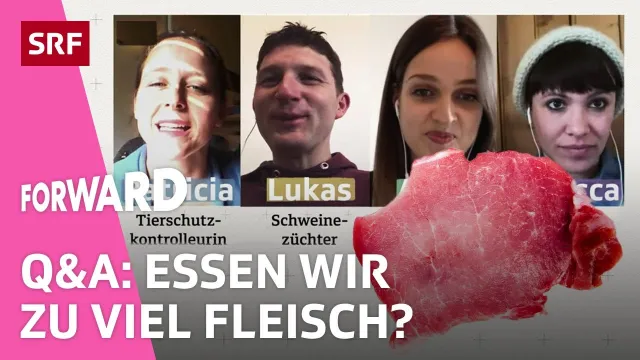 Frequently searched questions about factory farming and meat consumptionSRF Impact, 4 min
Four short answers to questions often searched online, for example whether there is an alternative to factory farming.
 How good is Swiss animal protection law really?Stiftung für das Tier im Recht, 22 min
Conversation with the foundation's director on the strengths and weaknesses of Swiss animal protection law.
Sources
- Animal Welfare Ordinance SR 455.1, as of 1 Feb 2026 (seen 21 Nov 2026)
- Proviande: dossier on animal keeping (BFS farm census supplementary survey 2020: 42.5 percent of dairy cow places in tie stalls, seen 21 Nov 2026)
- Bio Suisse standards 2026, part II (Knospe)
- Demeter Switzerland standards 2026
- IP-SUISSE animal husbandry guidelines (as of March 2026)
- KAGfreiland animal husbandry guidelines 2026
- Direct Payments Ordinance SR 910.13, as of 1 Jan 2026 (seen 21 Nov 2026)
- Organic Farming Ordinance SR 910.18 (Fedlex)
- Everything on Dairy
- How long do dairy cows live?
- Are calves separated from their mothers?
- What do dairy cows lie on?
- Do dairy cows get to graze on pasture?
- Are dairy cows' horns removed?
- How long are cows transported?
- How are dairy cows slaughtered?
- Label: Legal minimum
- Label: BTS and RAUS (federal programmes)
- Label: IP-SUISSE
- Label: Organic under the Swiss ordinance
- Label: Knospe (Bio Suisse)
- Label: Demeter
- Label: KAGfreiland
- Knospe (Bio Suisse) vs Organic under the Swiss ordinance: Dairy
- Knospe (Bio Suisse) vs Demeter: Dairy
- BTS and RAUS (federal programmes) vs Organic under the Swiss ordinance: Dairy
- Knospe (Bio Suisse) vs IP-SUISSE: Dairy