 How my food lives
Dairy · Outdoors
Do dairy cows get to graze on pasture?
Pasture on 26 days a month in summer and 13 days in winter is usual. Furthest along: KAGfreiland. Weakest: Legal minimum (Animal Welfare Ordinance, TSchV).
Why it is like this
That is the RAUS (Swiss programme for regular outdoor access) rule on which almost all labels depend. The law alone requires a run only for tied cows. KAGfreiland requires daily grazing.
What the labels say
| Standard | Level |
|---|---|
| Legal minimum (Animal Welfare Ordinance, TSchV) | 1 Never. A bright barn is enough |
| BTS and RAUS (Swiss federal programmes: animal-friendly housing and regular outdoor access) | 3 On a few days a week |
| IP-SUISSE meadow milk | 3 On a few days a week |
| Organic under the Swiss Organic Farming Ordinance | 3 On a few days a week |
| Knospe (Bio Suisse organic label, "the bud") | 3 On a few days a week |
| Demeter (Switzerland) | 3 On a few days a week |
| KAGfreiland | 4 On almost every day |
How we read the levels
- Never. A bright barn is enough.
- Never, but it feels fresh air in the barn.
- On a few days a week.
- On almost every day.
Level 1: Never. A bright barn is enough.
Applies to: Legal minimum (Animal Welfare Ordinance, TSchV)
Under the legal minimum the cow does not go outside regularly. The law requires a run only for tied cows.
For tethered cattle the Animal Welfare Ordinance requires a run on 60 days from May to October and 30 days from November to April (art. 40 para. 1). A pasture duty is not in the law.
Level 3: On a few days a week.
Applies to: BTS and RAUS (Swiss federal programmes: animal-friendly housing and regular outdoor access), IP-SUISSE meadow milk, Organic under the Swiss Organic Farming Ordinance, Knospe (Bio Suisse organic label, "the bud") and Demeter (Switzerland)
Under RAUS (Swiss programme for regular outdoor access), organic, Knospe, Demeter and IP-SUISSE the cow goes out on a large share of days, in summer almost every day, in winter on a little over every second day.
RAUS requires pasture on 26 days a month from May to October and 13 days a month from November to April (Direct Payments Ordinance, annex 6 B 2.1). Knospe additionally requires 25 percent of the daily dry matter to come from pasture (part II 4.1.2). IP-SUISSE Wiesenmilch requires RAUS; the pasture share counts only as points in a points system, with no fixed value (5.5.1, 5.5.3). What happens outdoors in winter is, for tethered cows, a run, not grazing.
Level 4: On almost every day.
Applies to: KAGfreiland
Under KAGfreiland the cow goes out on pasture every day in the growing season, and otherwise has permanent access to a paddock.
KAGfreiland: daily grazing in the growing season, permanent paddock outside it (guideline 2.4, 6.2.3).
Videos
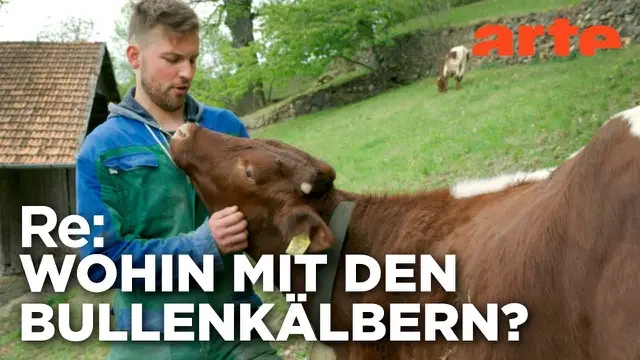 From throwaway calf to saviour of the AlpsARTE, 30 min
Male calves from dairy farming are treated as waste. The film follows farmers in the Allgäu who fatten them on pastures and alpine meadows.
Sources
- Animal Welfare Ordinance SR 455.1, as of 1 Feb 2026 (seen 21 Nov 2026)
- Direct Payments Ordinance SR 910.13, as of 1 Jan 2026 (seen 21 Nov 2026)
- Bio Suisse standards 2026, part II (Knospe)
- IP-SUISSE animal husbandry guidelines (as of March 2026)
- Demeter Switzerland standards 2026
- Organic Farming Ordinance SR 910.18 (Fedlex)
- KAGfreiland animal husbandry guidelines 2026
- Everything on Dairy
- How long do dairy cows live?
- Are calves separated from their mothers?
- How much room do dairy cows have?
- What do dairy cows lie on?
- Are dairy cows' horns removed?
- How long are cows transported?
- How are dairy cows slaughtered?
- Label: Legal minimum
- Label: BTS and RAUS (federal programmes)
- Label: IP-SUISSE
- Label: Organic under the Swiss ordinance
- Label: Knospe (Bio Suisse)
- Label: Demeter
- Label: KAGfreiland
- Knospe (Bio Suisse) vs Organic under the Swiss ordinance: Dairy
- Knospe (Bio Suisse) vs Demeter: Dairy
- BTS and RAUS (federal programmes) vs Organic under the Swiss ordinance: Dairy
- Knospe (Bio Suisse) vs IP-SUISSE: Dairy