 How my food lives
Eggs · Lifespan
How long do laying hens live?
Could live several years. Is slaughtered after about a year and a half. The same for every label: For the laying hens themselves rung 2 applies: they are slaughtered after the laying period, when output drops.
Why it is like this
An organic hen on a commercial farm lives to over 80 weeks of age. After that the animals are slaughtered. In 2025 Switzerland produced 1.2 billion eggs, 18.9 percent of them organic, and self-sufficiency was 62.6 percent. Since 1 January 2026 the laying hens' brothers are no longer killed on a large scale. Organic farms raise them and slaughter them after at least 63 days; for conventional eggs the sex is determined in the egg.
What the labels say
How we read the levels
- Until it is big enough to be used. It may still be very young.
- Until it is at least fully grown.
- Until it has lived half of its possible life.
- Until it is old.
- Until it dies of its own accord.
Level 2: Until it is at least fully grown.
For the laying hens themselves rung 2 applies: they are slaughtered after the laying period, when output drops. They are grown but not old.
The life of an organic hen in professional keeping is over 80 weeks of age, so about a year and a half including rearing (Marktspiegel Bio-Eier 2025). More than three quarters of organic farms have already extended the laying period. Under Knospe flocks of 250 or more are slaughtered after use (part II 5.5.4.15). How old a hen can get is not reliably documented in our sources. Their brothers: Knospe and Demeter let them grow up as brother roosters, slaughtered after at least 63 days. In 2025 Switzerland produced about 1.2 billion eggs.
Videos
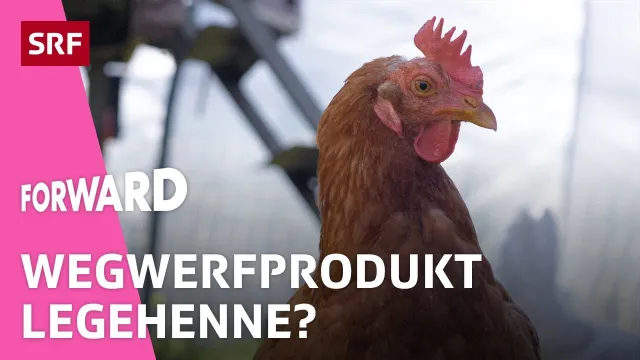 Mass product egg: why laying hens live a short lifeSRF Impact, 8 min
Short report from Switzerland: about two million healthy laying hens are killed every year. The film asks what potential is left in them.
Note: this video shows images some people find distressing.
End of chick culling: will we soon eat breakfast eggs with a clear conscience?SRF Wissen (Einstein), 35 minScience programme on the killing of male chicks in Switzerland and the ways to stop it: sexing in the egg and raising the brothers.
 FiBL Focus: livestock keeping, exploitation or fair deal?FiBL, 45 min
An animal scientist at FiBL explains why in his view species-appropriate keeping does not exist, and what that means for consumption.
Sources
- Bio Suisse / bioaktuell.ch: organic egg market overview 2025 (seen 21 Nov 2026)
- Bio Suisse standards 2026, part II (Knospe)
- Demeter Switzerland standards 2026
- Animal Welfare Ordinance SR 455.1, as of 1 Feb 2026 (seen 21 Nov 2026)
- KAGfreiland animal husbandry guidelines 2026
- SRF Espresso: the end of chick killing from New Year (25 Nov 2025, seen 21 Nov 2026)
- Everything on Eggs
- Do laying hens ever see their mother?
- How much space does a laying hen have?
- Where do laying hens sleep and rest?
- How often are laying hens outside?
- Are laying hens' beaks trimmed?
- How long are laying hens transported?
- How are laying hens killed?
- Label: Legal minimum
- Label: BTS and RAUS (federal programmes)
- Label: Organic under the Swiss ordinance
- Label: Knospe (Bio Suisse)
- Label: Demeter
- Label: KAGfreiland
- Label: IP-SUISSE
- Label: Coop Naturafarm
- Knospe (Bio Suisse) vs Organic under the Swiss ordinance: Eggs
- Knospe (Bio Suisse) vs Demeter: Eggs
- BTS and RAUS (federal programmes) vs Organic under the Swiss ordinance: Eggs
- Knospe (Bio Suisse) vs IP-SUISSE: Eggs