 How my food lives
Beef · The final journey
How long are cattle transported to slaughter?
Usual: up to 6 hours of driving, 8 hours in all. Level at the front: Demeter (Switzerland) and KAGfreiland. Weakest: 10 standards, among them Legal minimum (Animal Welfare Ordinance, TSchV) and BTS and RAUS (Swiss federal programmes: animal-friendly housing and regular outdoor access).
Why it is like this
The law allows at most 6 hours of driving and 8 hours of transport. Demeter allows at most 3 hours, KAGfreiland 2, and 3 in an exception. Bio Weide-Beef names 6 hours of pure driving at most.
What the labels say
| Standard | Level |
|---|---|
| Legal minimum (Animal Welfare Ordinance, TSchV) | 2 After a journey of a few hours, at a slaughterhouse |
| BTS and RAUS (Swiss federal programmes: animal-friendly housing and regular outdoor access) | 2 After a journey of a few hours, at a slaughterhouse |
| Organic under the Swiss Organic Farming Ordinance | 2 After a journey of a few hours, at a slaughterhouse |
| Knospe (Bio Suisse organic label, "the bud") | 2 After a journey of a few hours, at a slaughterhouse |
| Demeter (Switzerland) | 3 After a short journey, at a slaughterhouse nearby |
| KAGfreiland | 3 After a short journey, at a slaughterhouse nearby |
| Natura-Beef (Mutterkuh Schweiz) | 2 After a journey of a few hours, at a slaughterhouse |
| Natura-Veal (Mutterkuh Schweiz) | 2 After a journey of a few hours, at a slaughterhouse |
| IP-SUISSE pasture beef (also sold as Migros Weide-Beef) | 2 After a journey of a few hours, at a slaughterhouse |
| Silvestri pasture beef (IP-SUISSE) | 2 After a journey of a few hours, at a slaughterhouse |
| Bio Weide-Beef (organic pasture beef, Mutterkuh Schweiz and Bio Suisse) | 2 After a journey of a few hours, at a slaughterhouse |
| Coop Naturafarm beef and veal (produced under Mutterkuh Schweiz rules: Natura-Beef, Natura-Veal, Naturafarm Auslaufrind, Naturafarm Weiderind) | 2 After a journey of a few hours, at a slaughterhouse |
How we read the levels
- After a long journey, perhaps a whole day, at a large slaughterhouse.
- After a journey of a few hours, at a slaughterhouse.
- After a short journey, at a slaughterhouse nearby.
- At home on the farm or pasture, with no journey.
Level 2: After a journey of a few hours, at a slaughterhouse.
Applies to: Legal minimum (Animal Welfare Ordinance, TSchV), BTS and RAUS (Swiss federal programmes: animal-friendly housing and regular outdoor access), Organic under the Swiss Organic Farming Ordinance, Knospe (Bio Suisse organic label, "the bud"), Natura-Beef (Mutterkuh Schweiz), Natura-Veal (Mutterkuh Schweiz), IP-SUISSE pasture beef (also sold as Migros Weide-Beef), Silvestri pasture beef (IP-SUISSE), Bio Weide-Beef (organic pasture beef, Mutterkuh Schweiz and Bio Suisse) and Coop Naturafarm beef and veal (produced under Mutterkuh Schweiz rules: Natura-Beef, Natura-Veal, Naturafarm Auslaufrind, Naturafarm Weiderind)
A trip of a few hours: by law at most 6 hours of driving and 8 hours of transport. Bio Weide-Beef names 6 hours of pure driving at most.
The permitted duration of transport, driving time included, is eight hours (Art. 152a TSchV), the driving time six at most (Art. 15 para. 1 TSchG). In the EU longer trips are allowed for cattle: 14 hours, one hour of rest, then another 14 hours (Regulation (EC) 1/2005, Annex I Chapter V 1.4, with additional conditions). Knospe, Natura-Beef, IP-SUISSE and Silvestri refer to the guideline of the Kontrolldienst STS, and electric prods are banned at several labels.
Level 3: After a short journey, at a slaughterhouse nearby.
Applies to: Demeter (Switzerland) and KAGfreiland
A short trip: at Demeter at most 3 hours, at KAGfreiland at most 2, and 3 in a justified exception.
Demeter wants animals killed on the farm or pasture or taken only a short way to a local slaughterhouse; transport may not exceed 3 hours, and the keeper may accompany the animal (7.6.1.7). KAGfreiland: at most two hours from loading the last animal to arrival (4.3).
What stays open
There is no rule on this that we found.
Videos
Note: this video shows images some people find distressing.
Mona Vetsch at an on-farm slaughterSRF Dok, 33 minOn an organic farm in Graubünden the animals are slaughtered where they were born. The film shows a slaughter and warns beforehand.
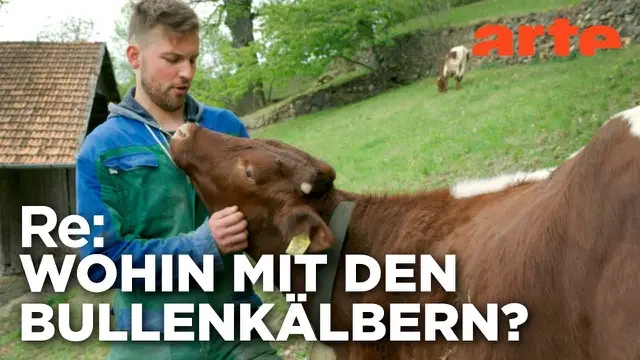 From throwaway calf to saviour of the AlpsARTE, 30 min
Male calves from dairy farming are treated as waste. The film follows farmers in the Allgäu who fatten them on pastures and alpine meadows.
Sources
- Kontrolldienst STS: transport of large and small livestock, annex 1, valid from 1 Jul 2026 (2025 version compared: only the loading-gate sanction from 1 Jul 2027 is new, no change to travel time, duration or loading density)
- Animal Welfare Act SR 455, as of 1 Sep 2023 (seen 21 Nov 2026)
- Animal Welfare Ordinance SR 455.1, as of 1 Feb 2026 (seen 21 Nov 2026)
- Bio Suisse standards 2026, part II (Knospe)
- Demeter Switzerland standards 2026
- KAGfreiland animal husbandry guidelines 2026
- Mutterkuh Schweiz: production rules for Natura-Beef and Natura-Veal, 10 Sep 2024
- IP-SUISSE animal husbandry guidelines (as of March 2026)
- Silvestri brand programmes, guidelines for large livestock, valid from 1 Jan 2026 (flat table)
- Mutterkuh Schweiz, guideline Bio Weide-Beef, valid from 1 Jan 2026
- Coop Naturafarm basic standards, released December 2020 (archive copy of 3 Jun 2025)
- Mutterkuh Schweiz, production rules for Premium-Beef, Naturafarm Auslaufrind and SwissPrimBeef, 28 Jan 2025
- Mutterkuh Schweiz, production rules for Naturafarm Weiderind, 12 Nov 2024
- Everything on Beef
- How long do beef bulls live?
- How long do calves stay with their mother?
- How much space does a fattening bull have?
- What do beef cattle lie on?
- Do beef cattle get out to pasture?
- Are cattle dehorned?
- How are cattle slaughtered?
- Label: Legal minimum
- Label: BTS and RAUS (federal programmes)
- Label: Organic under the Swiss ordinance
- Label: Knospe (Bio Suisse)
- Label: Demeter
- Label: KAGfreiland
- Label: Natura-Beef and Natura-Veal
- Label: IP-SUISSE
- Label: Silvestri (free-range pig, alpine pig, pasture beef)
- Label: Bio Weide-Beef
- Label: Coop Naturafarm
- Knospe (Bio Suisse) vs Organic under the Swiss ordinance: Beef
- Knospe (Bio Suisse) vs Demeter: Beef
- BTS and RAUS (federal programmes) vs Organic under the Swiss ordinance: Beef
- Knospe (Bio Suisse) vs IP-SUISSE: Beef