 How my food lives
Beef · Freedom of movement
How much space does a fattening bull have?
Usual: a loose-housing barn, with a quarter of the animals in a tie-stall. Here the standards barely differ: 7 reach level 3.
Why it is like this
In 2020, 27 percent of Swiss cattle stood in tie-stalls and 73 percent in loose-housing barns, with 42.5 percent of dairy cows tethered. The law allows tethering with a run, and Knospe and Demeter allow it too. BTS and RAUS (Swiss programmes for animal-friendly housing and regular outdoor access) apply at Natura-Beef, IP-SUISSE Weidebeef and Bio Weide-Beef.
What the labels say
How we read the levels
- Stand up and lie down again.
- Turn around and stretch out its whole body.
- Walk around without getting in anyone's way.
- Run and play.
Level 1: Stand up and lie down again.
Applies to: Legal minimum (Animal Welfare Ordinance, TSchV), Organic under the Swiss Organic Farming Ordinance, Knospe (Bio Suisse organic label, "the bud"), Demeter (Switzerland) and KAGfreiland
The animal can stand up and lie down: the law allows tethering if the animals get a run. The organic ordinance, Knospe, Demeter and KAGfreiland (with exceptions) allow it as well.
Tethered cattle must get a run on at least 60 days from 1 May to 31 October and on at least 30 days from 1 November to 30 April, and may stay without a run for two weeks at most (Art. 40 TSchV). Knospe allows tethering of cattle if the RAUS (Swiss programme for regular outdoor access) rules are kept (Part II 4.1.1.1). In 2020, 27 percent of Swiss cattle and 42.5 percent of dairy cows stood in tie-stalls (FSO, via Proviande). KAGfreiland bans tethering in principle but allows exceptions for existing barns (2.3), which is why the table shows it at 1 to 3 and counts 1.
Level 3: Walk around without getting in anyone's way.
Applies to: BTS and RAUS (Swiss federal programmes: animal-friendly housing and regular outdoor access), Natura-Beef (Mutterkuh Schweiz), Natura-Veal (Mutterkuh Schweiz), IP-SUISSE pasture beef (also sold as Migros Weide-Beef), Silvestri pasture beef (IP-SUISSE), Bio Weide-Beef (organic pasture beef, Mutterkuh Schweiz and Bio Suisse) and Coop Naturafarm beef and veal (produced under Mutterkuh Schweiz rules: Natura-Beef, Natura-Veal, Naturafarm Auslaufrind, Naturafarm Weiderind)
Possible on some farms, not guaranteed: KAGfreiland
The animal can walk about: BTS requires a loose-housing barn or group keeping with a lying area, and Natura-Beef, IP-SUISSE Weidebeef, Bio Weide-Beef and Coop Naturafarm require BTS and RAUS (Swiss programmes for animal-friendly housing and regular outdoor access).
BTS and RAUS apply to all animals at Natura-Beef (regulation 2.4 lit. g), IP-SUISSE Weidebeef (5.2.1) and Bio Weide-Beef (5.2.8). Natura-Beef and Natura-Veal animals go with the suckler herd in a loose-housing barn or on pasture. In 2020, 73 percent of Swiss cattle stood in loose-housing barns (FSO, via Proviande). We read no square-metre figure per fattening animal at these labels. That the area is enough for walking about without bumping is our reading.
What stays open
There is no rule on this that we found.
Videos
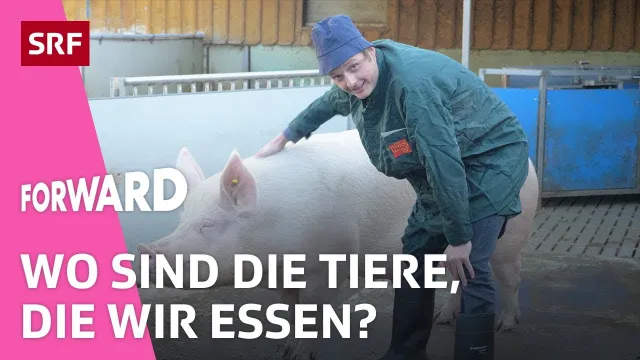 Livestock farming in Switzerland: where are the animals we eat?SRF Impact, 8 min
A reporter who looks after woolly pigs himself asks why we see so little of the pigs, cattle and chickens living in Switzerland.
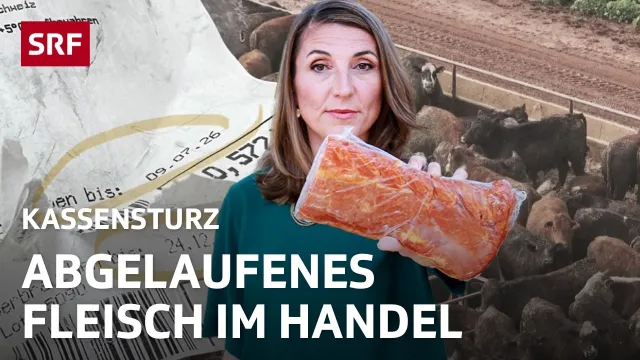 Food waste and animal suffering: the Swiss meat industry under criticismSRF Kassensturz, 24 min
Kassensturz shows expired meat at a wholesaler and cattle in feedlots in Uruguay whose meat is sold in Switzerland.
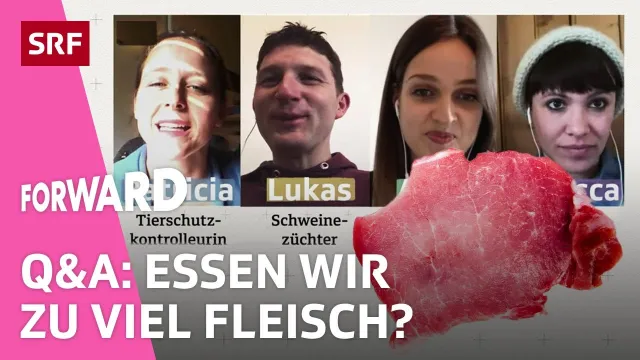 Frequently searched questions about factory farming and meat consumptionSRF Impact, 4 min
Four short answers to questions often searched online, for example whether there is an alternative to factory farming.
Sources
- Proviande: dossier on animal keeping (2022, with figures from the 2025 Agrarbericht, BFS farm census 2020)
- Mutterkuh Schweiz, production rules for Premium-Beef, Naturafarm Auslaufrind and SwissPrimBeef, 28 Jan 2025
- Mutterkuh Schweiz, production rules for Naturafarm Weiderind, 12 Nov 2024
- Animal Welfare Ordinance SR 455.1, as of 1 Feb 2026 (seen 21 Nov 2026)
- Direct Payments Ordinance SR 910.13, as of 1 Jan 2026 (seen 21 Nov 2026)
- Organic Farming Ordinance SR 910.18 (Fedlex)
- Bio Suisse standards 2026, part II (Knospe)
- Demeter Switzerland standards 2026
- KAGfreiland animal husbandry guidelines 2026
- Mutterkuh Schweiz: production rules for Natura-Beef and Natura-Veal, 10 Sep 2024
- IP-SUISSE animal husbandry guidelines (as of March 2026)
- Mutterkuh Schweiz, guideline Bio Weide-Beef, valid from 1 Jan 2026
- Coop Naturafarm basic standards, released December 2020 (archive copy of 3 Jun 2025)
- Everything on Beef
- How long do beef bulls live?
- How long do calves stay with their mother?
- What do beef cattle lie on?
- Do beef cattle get out to pasture?
- Are cattle dehorned?
- How long are cattle transported to slaughter?
- How are cattle slaughtered?
- Label: Legal minimum
- Label: BTS and RAUS (federal programmes)
- Label: Organic under the Swiss ordinance
- Label: Knospe (Bio Suisse)
- Label: Demeter
- Label: KAGfreiland
- Label: Natura-Beef and Natura-Veal
- Label: IP-SUISSE
- Label: Silvestri (free-range pig, alpine pig, pasture beef)
- Label: Bio Weide-Beef
- Label: Coop Naturafarm
- Knospe (Bio Suisse) vs Organic under the Swiss ordinance: Beef
- Knospe (Bio Suisse) vs Demeter: Beef
- BTS and RAUS (federal programmes) vs Organic under the Swiss ordinance: Beef
- Knospe (Bio Suisse) vs IP-SUISSE: Beef