 How my food lives
Fish · Freedom of movement
How much space do farmed fish have?
Usual: no legal limit on the number of fish in the water. Level at the front: Wild catch, no label and MSC. Weakest: 3 standards, among them Farmed fish (legal minimum) and ASC (aquaculture).
Why it is like this
EU farm animal law leaves fish out of its Annex, so only a general duty not to cause unnecessary suffering remains. Organic rules cap density by species: 10 kg/m3 for salmon in net pens, 15 for sea bass and sea bream, 25 for trout. ASC asks farms to calculate their density but sets no upper limit. The Label Rouge recueil says only that its fish are kept at lower densities than ordinary products, without a number.
What the labels say
| Standard | Level |
|---|---|
| Wild catch, no label | 4 Run and play |
| MSC | 4 Run and play |
| Farmed fish (legal minimum) | 1 Stand up and lie down again |
| ASC (aquaculture) | 1 Stand up and lie down again |
| AB aquaculture (EU organic fish) | 2-3 level 2 guaranteed (Turn around and stretch out its whole body); up to level 3 depending on the farm |
| Label Rouge fish (salmon, trout, sea bass, bream) | 1 Stand up and lie down again |
How we read the levels
- Stand up and lie down again.
- Turn around and stretch out its whole body.
- Walk around without getting in anyone's way.
- Run and play.
Level 1: Stand up and lie down again.
Applies to: Farmed fish (legal minimum), ASC (aquaculture) and Label Rouge fish (salmon, trout, sea bass, bream)
No rule limits how many farmed fish are kept in the water. Directive 98/58/EC leaves fish out of its Annex. ASC only asks the farm to calculate its stocking density and sets no cap. The Label Rouge fish rule books were not read, so that row takes the legal floor.
Directive 98/58/EC Art. 4: the conditions in the Annex apply to animals 'other than fish, reptiles or amphibians'. Only the general duty of Art. 3 (no unnecessary pain, suffering or injury) remains. For the Label Rouge fish rows (salmon, trout, sea bass, bream) the 2026 recueil says only that densities are lower than for the ordinary product, without figures. ASC Farm Standard 4.1.1.12: the farm calculates its stocking density by the method of Appendix 12, with no upper limit. The ASC salmon on French shelves is farmed outside France, so French law is not its floor; the law of the farming country was not checked, which leaves level 1. Label Rouge fish take the legal value as their floor ('at least the law'), because their rule books were not read.
Level 2: Turn around and stretch out its whole body.
Applies to: AB aquaculture (EU organic fish)
Some room in the water: organic trout may be kept at up to 25 kg of fish per cubic metre.
Regulation (EU) 2020/464, Annex I Part III: rainbow trout and brown trout 25 kg/m3. Under our scoring rule up to 25 kg/m3 is rung 2. Organic fish are scored 2 to 3, by the species sold in France.
Level 3: Walk around without getting in anyone's way.
Possible on some farms, not guaranteed: AB aquaculture (EU organic fish)
More room in the water: organic salmon may be kept at up to 10 kg per cubic metre in net pens, sea bass and sea bream at up to 15 kg.
Regulation (EU) 2020/464, Annex I Part III: salmon 10 kg/m3 in net pens (20 kg/m3 in fresh water), sea bass and sea bream 15 kg/m3. Under our scoring rule up to 20 kg/m3 is rung 3. We did not read the ASC density tables.
Level 4: Run and play.
Applies to: Wild catch, no label and MSC
A spacious open water: this is the natural state of wild fish and of MSC fish. It is biology, not a rule.
No density figure applies to a wild fish. MSC is a stock label, and its standard was not read here.
What stays open
ASC asks farms to calculate their density but sets no cap, and the Label Rouge fish rule books were not read. Both rows stay at level 1.
Videos
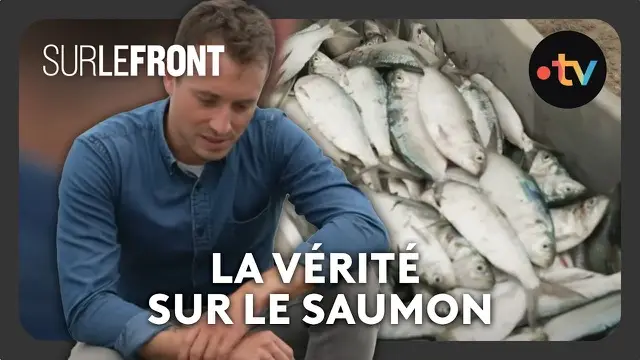 The truth about salmon (full film): Sur le front with Hugo ClémentSur le front avec Hugo Clément -France Télévisions
Sur le front: European salmon farming and a planned farm in Boulogne-sur-Mer.
Note: this video shows images some people find distressing.
Fish: how are trout farmed in France?L214 Éthique & AnimauxL214 investigation of trout farming and slaughter at Aqualande. (film from an advocacy group)
Further reading
- EUR-Lex: Directive 98/58/EC, protection of farmed animals (Legal text)
- INAO: Recueil of Label Rouge guidelines, April 2026 (in French) (Guidelines, PDF)
Sources
- Directive 98/58/EC: protection of farmed animals (legal text)
- INAO, Recueil des orientations du Label Rouge, version of 9 April 2026
- Regulation (EU) 2020/464: detailed organic rules on stocking densities, outdoor areas, poultry houses and milk feeding (legal text)
- Own reading of biology (no rule document)
- ASC Farm Standard V1.0.1A2 (August 2026)
- Everything on Fish
- How old are fish when they are killed for food?
- Do farmed fish ever see their parents?
- What does a farmed fish's habitat look like?
- Do farmed fish live outdoors?
- What treatments do farmed fish get?
- How long are live fish transported?
- How are fish killed?
- Label: Wild-caught fish without a label
- Label: MSC (wild fish)
- Label: Legal minimum (EU and French law)
- Label: ASC (farmed fish)
- Label: AB / EU organic
- Label: Label Rouge
- Legal minimum (EU and French law) vs Label Rouge: Fish
- Legal minimum (EU and French law) vs AB / EU organic: Fish
- Label Rouge vs AB / EU organic: Fish