 How my food lives
Fish · Lifespan
How old are fish when they are killed for food?
Slaughtered as soon as the fish reaches eating size. Level at the front: Wild catch, no label and MSC. Weakest: 4 standards, among them Farmed fish (legal minimum) and ASC (aquaculture).
Why it is like this
No rule in French or EU law, and none in AB or ASC, sets a minimum age for farmed fish. The highest ages reported by FishBase are 30 years for European sea bass, 14 for gilthead sea bream, 13 for Atlantic salmon and 11 for rainbow trout. The pages do not say whether these fish lived in the wild or in care, so this is an upper limit and not a usual value. We opened no French figure for the age of farmed fish at slaughter.
What the labels say
| Standard | Level |
|---|---|
| Wild catch, no label | 1-4 level 1 guaranteed (Until it is big enough to be used. It may still be very young); up to level 4 depending on the farm |
| MSC | 1-4 level 1 guaranteed (Until it is big enough to be used. It may still be very young); up to level 4 depending on the farm |
| Farmed fish (legal minimum) | 1 Until it is big enough to be used. It may still be very young |
| ASC (aquaculture) | 1 Until it is big enough to be used. It may still be very young |
| AB aquaculture (EU organic fish) | 1 Until it is big enough to be used. It may still be very young |
| Label Rouge fish (salmon, trout, sea bass, bream) | 1 Until it is big enough to be used. It may still be very young |
How we read the levels
- Until it is big enough to be used. It may still be very young.
- Until it is at least fully grown.
- Until it has lived half of its possible life.
- Until it is old.
- Until it dies of its own accord.
Level 1: Until it is big enough to be used. It may still be very young.
Applies to: Wild catch, no label, MSC, Farmed fish (legal minimum), ASC (aquaculture), AB aquaculture (EU organic fish) and Label Rouge fish (salmon, trout, sea bass, bream)
A farmed fish is slaughtered as soon as it reaches eating size, long before the end of its possible life. No French or EU rule sets a minimum age for farmed fish, and neither AB nor ASC does. With no rule read on this point, Label Rouge fish are scored at this legal floor. Wild and MSC fish start here as well, because they may be caught young (see level 4).
Directive 98/58/EC on farmed animals leaves out fish in its Annex (Art. 4), so only the general duty of Art. 3 applies. For the possible life span, FishBase gives maximum reported ages of 11 years for rainbow trout, 13 years for Atlantic salmon, 14 years for gilthead sea bream and 30 years for European sea bass. The pages do not say whether such fish lived in the wild or in care, so these are upper limits and not usual values. We opened no French figure for the age or weight of farmed fish at slaughter (the FAO fact sheets we tried returned no content). Under our scoring rule, a row whose rule was not read takes the legal value as its floor ('at least the law'): wild fish, MSC fish and the Label Rouge fish rows sit here for that reason, not because a rule was found.
Level 4: Until it is old.
Possible on some farms, not guaranteed: Wild catch, no label and MSC
A wild fish lives free in the sea, a lake or a river until it is caught. It may be caught young or old, and no rule sets an age, so wild and MSC fish range from level 1 to level 4.
Biology, not a written rule. Fishing rules set minimum sizes for many species, which we did not read, but no age. MSC is a label for the fish stock and the fishery, not for the life of one fish. Only the low end, level 1, is guaranteed.
What stays open
Label Rouge fish (salmon, trout, sea bass, bream) has no readable rule on age: the cahiers des charges (individual rule books) were not read. It is scored at the legal floor.
Videos
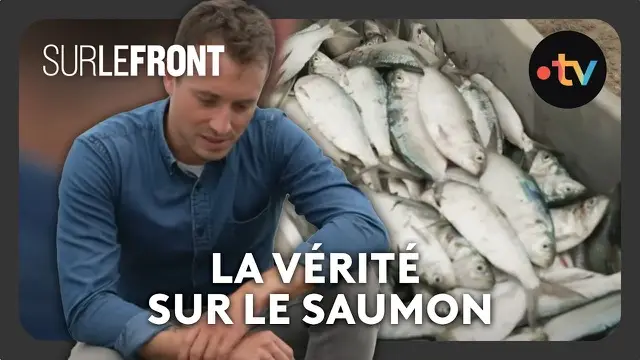 The truth about salmon (full film): Sur le front with Hugo ClémentSur le front avec Hugo Clément -France Télévisions
Sur le front: European salmon farming and a planned farm in Boulogne-sur-Mer.
Further reading
- EUR-Lex: Directive 98/58/EC, protection of farmed animals (Legal text)
- FishBase: rainbow trout (Database page)
- FishBase: Atlantic salmon (Database page)
- FishBase: gilthead sea bream (Database page)
Sources
- Directive 98/58/EC: protection of farmed animals (legal text)
- FishBase: rainbow trout, maximum reported age
- FishBase: Atlantic salmon, maximum reported age
- FishBase: gilthead sea bream, maximum reported age
- FishBase: European sea bass, maximum reported age
- Wild catch (scale ruling R36): the fish lives free in the sea, lake or river until it is caught; it may be caught young or old, and no rule sets an age (biology, no document)
- Own reading of biology (no rule document)
- ASC Farm Standard V1.0.1A2 (August 2026)
- INAO, Recueil des orientations du Label Rouge, version of 9 April 2026
- Everything on Fish
- Do farmed fish ever see their parents?
- How much space do farmed fish have?
- What does a farmed fish's habitat look like?
- Do farmed fish live outdoors?
- What treatments do farmed fish get?
- How long are live fish transported?
- How are fish killed?
- Label: Wild-caught fish without a label
- Label: MSC (wild fish)
- Label: Legal minimum (EU and French law)
- Label: ASC (farmed fish)
- Label: AB / EU organic
- Label: Label Rouge
- Legal minimum (EU and French law) vs Label Rouge: Fish
- Legal minimum (EU and French law) vs AB / EU organic: Fish
- Label Rouge vs AB / EU organic: Fish