 How my food lives
Product
Fish: welfare and labels compared
Natural lifespan: carp up to 38 years, trout and salmon 11 to 13 (FishBase). In practice: at market size. Wild-caught and farmed. The questions apply to fish as well; how we read them is below. We give no fish price for now, and no rule on welfare was found for wild catch.
Eight questions, eight answers
- How old are fish when they are killed for food?
Slaughtered as soon as the fish reaches eating size. - Do farmed fish ever see their parents?
Usual: the young fish never see their parents. - How much space do farmed fish have?
Usual: no rule on stocking density for farmed fish. - What does a farmed fish's habitat look like?
Usual: a net pen or a tank without structures. - Do farmed fish live outdoors?
Usual: no duty to be outdoors; the young live in hatcheries indoors. - What treatments do farmed fish get?
Usual: no rule on treatments in the Spanish farm decree. - How long are live fish transported?
Usual: no hour limit for fish. - How are fish killed?
For fish no standard shows a death without fear.
Labels and standards at a glance
| Standard | Lifespan | Mother and young | Freedom of movement | Resting place | Outdoors | Physical interventions | The final journey | Death |
|---|---|---|---|---|---|---|---|---|
| Wild catch with no label | 1-4 | 4 | 4 | 4 | 4 | 4 | 4 | 1 |
| MSC | 1-4 | 4 | 4 | 4 | 4 | 4 | 4 | 1 |
| Farmed fish (legal minimum) | 1 | 1 | 1 | 1 | 1 | 1 | 1 | 1 |
| ASC (aquaculture) | 1 | 1 | 1 | 1 | 3 | 1 | 1 | 1 |
| Acuicultura ecológica (EU organic) | 1 | 1 | 2-3 | 1 | 2 | 2-3 | 1 | 2 |
Level 1 is the lowest, the top level of the question is the best. A range such as 2-3 means our sources do not settle on one level. ? = no fixed rule.
Prices
| Standard | typical | range | What was priced |
|---|---|---|---|
| ASC (aquaculture) | 39.44 € per kg | 27.00 € to 54.95 € | Frozen ASC salmon, portions, n=4, as of 22 Nov 2026 Eroski, Alcampo |
Videos
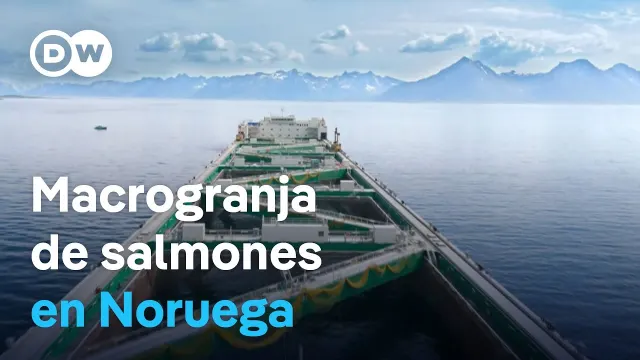 The world's largest salmon farm: a sustainable alternative?DW Español, 8 min
Salmon farming in Norway and whether it can be done in a way that suits the species.
 The salmon industry looks to technology to cut high mortalityDW Español, 13 min
Chile, second-largest salmon producer: high mortality, antibiotic use and the technical fixes the industry seeks.
 A pedir de boca: aquaculture, farmed fishRTVE Cocina, 28 min
RTVE Cocina programme on sea bream, sea bass and sole from the Bay of Cadiz salt marshes and turbot in Galicia. An industry view, not a welfare film.
Note: this video shows images some people find distressing.
Agony under water: investigation in Spanish fish farms 2024AnimaNaturalis, 6 minInvestigation by AnimaNaturalis, an animal advocacy group, in Spanish fish farms in 2024. Shows fish dying.
 Fish welfare guide in Spanish aquaculture, vol. 5: turbotAcuicultura de España, 2 min
APROMAR, the aquaculture trade body, presents a turbot welfare guide made with scientists and animal welfare organisations.
Sources
- Wild catch: the fish lives free until caught (own reading, as in Germany)
- Own reading of biology (no rule document)
- Regulation (EC) 1099/2009, protection of animals at killing (EUR-Lex)
- Real Decreto 348/2000, farm animals in general (BOE)
- Regulation (EC) 1/2005, protection of animals in transport (EUR-Lex)
- ASC Salmon and Cod Standard v1.5, October 2025 (asc-aqua.org, PDF)
- Danish Animal Welfare Act, consolidated act 994 of 2025
- ASC Farm Standard v1.0.1A2, mandatory for every audit from 1 May 2028 (programme-centre.asc-aqua.org)
- Danish order 817 of 2023: killing, including slaughter, of animals
- Regulation (EU) 2018/848, organic production, Annex II (EUR-Lex)
- Implementing Regulation (EU) 2020/464, organic stocking densities (EUR-Lex)
- Biology of the animals (Vier Pfoten, ProVieh, FishBase, FAO)
- MSC: how the fisheries standard works (msc.org)