 How my food lives
Pork · Resting place
What do pigs lie on in the barn?
Usual: a connected lying area with few holes. Here the standards barely differ: 11 reach level 3.
Why it is like this
Fully slatted floors in the lying area are banned in Switzerland. Straw is required only from BTS (Swiss programme for animal-friendly housing) up: a non-perforated lying area with straw. Knospe requires that all lying areas are bedded and have no holes. 56 percent of Swiss pig farms keep their pigs under BTS.
What the labels say
| Standard | Level |
|---|---|
| Legal minimum (Animal Welfare Ordinance, TSchV) | 2 A dry, clean spot that does not press or chafe |
| BTS (Swiss federal programme for especially animal-friendly housing) | 3 A dry, soft spot with straw |
| BTS and RAUS (Swiss federal programmes: animal-friendly housing and regular outdoor access) | 3 A dry, soft spot with straw |
| Organic under the Swiss Organic Farming Ordinance | 3 A dry, soft spot with straw |
| Knospe (Bio Suisse organic label, "the bud") | 3 A dry, soft spot with straw |
| Demeter (Switzerland) | 3 A dry, soft spot with straw |
| KAGfreiland | 3 A dry, soft spot with straw |
| IP-SUISSE (BTS and RAUS) | 3 A dry, soft spot with straw |
| Coop Naturafarm pork | 3 A dry, soft spot with straw |
| Lidl Cura Porc (formerly Terra Natura pigs) | 3 A dry, soft spot with straw |
| Silvestri free-range pig (IP-SUISSE) | 3 A dry, soft spot with straw |
| Silvestri alpine pig (IP-SUISSE and Pro Montagna) | 3 A dry, soft spot with straw |
How we read the levels
- A simple, dry, reasonably clean spot.
- A dry, clean spot that does not press or chafe.
- A dry, soft spot with straw.
- Several dry, soft spots with straw, so it can choose.
Level 2: A dry, clean spot that does not press or chafe.
Applies to: Legal minimum (Animal Welfare Ordinance, TSchV)
A connected lying area with only a few holes: that is what the law requires. Fully slatted floors in the lying area are not allowed in Switzerland.
Pigs need a lying area that is connected over larger surfaces and may have only a small share of perforation for liquids to drain (Art. 47 para. 1 TSchV). They must also be able to occupy themselves at all times with straw, roughage or equivalent material (Art. 44). Straw as bedding is not required by the law.
Level 3: A dry, soft spot with straw.
Applies to: BTS (Swiss federal programme for especially animal-friendly housing), BTS and RAUS (Swiss federal programmes: animal-friendly housing and regular outdoor access), Organic under the Swiss Organic Farming Ordinance, Knospe (Bio Suisse organic label, "the bud"), Demeter (Switzerland), KAGfreiland, IP-SUISSE (BTS and RAUS), Coop Naturafarm pork, Lidl Cura Porc (formerly Terra Natura pigs), Silvestri free-range pig (IP-SUISSE) and Silvestri alpine pig (IP-SUISSE and Pro Montagna)
A dry, soft lying place with straw: BTS (Swiss programme for animal-friendly housing), organic, Knospe, Demeter, KAGfreiland and the Silvestri pigs require this. At Knospe the lying place may have no holes at all.
BTS requires a non-perforated lying area with straw (Annex 6 DZV). At Knospe the lying areas may not be perforated, all must be bedded, and the bedding must be of organic quality (Part II 5.4.1). Lidl Cura Porc requires a dry lying area bedded over the whole floor with long straw or Chinese reed. At the Silvestri Freilandschwein the shelter is bedded with long straw or Chinese reed. A choice of several places, which the next step would need, we found nowhere.
What stays open
There is no rule on this that we found.
Videos
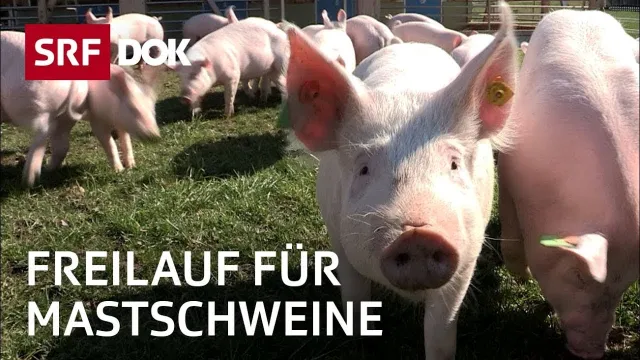 How a pig farmer wants to improve animal keepingSRF Dokus und Reportagen, 24 min
A farmer in canton Lucerne rebuilds a farm with 1,800 animals a year so that every pig can root, bathe and go out on grass.
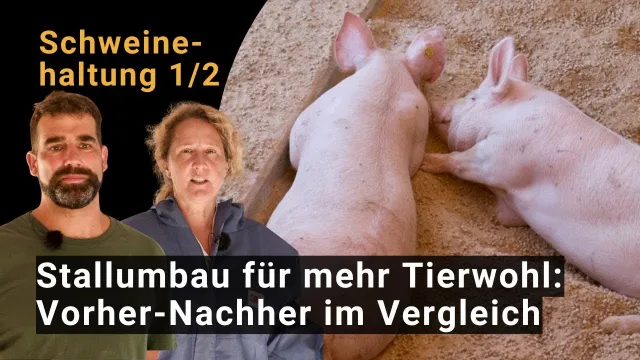 Before and after: rebuilding a barn for fattening pigsFiBL, 6 min
An adviser from the Research Institute of Organic Agriculture shows a conversion with a pool, outdoor run and rooting area.
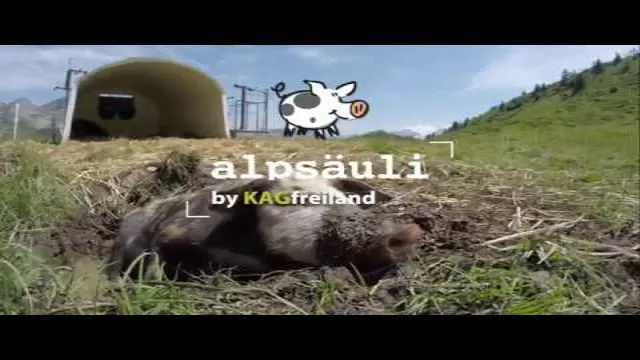 KAGfreiland alpine piglets know what is comfortableKAGfreiland, 2 min
Short film about pigs that lie in straw, on grass or in a wallow on the alp instead of on concrete slatted floors.
Sources
- Animal Welfare Ordinance SR 455.1, as of 1 Feb 2026 (seen 21 Nov 2026)
- Direct Payments Ordinance SR 910.13, as of 1 Jan 2026 (seen 21 Nov 2026)
- Bio Suisse standards 2026, part II (Knospe)
- Demeter Switzerland standards 2026
- KAGfreiland animal husbandry guidelines 2026
- IP-SUISSE animal husbandry guidelines (as of March 2026)
- Coop Naturafarm basic standards, released December 2020 (archive copy of 3 Jun 2025)
- Lidl Cura Porc pig guideline, valid from 1 Jan 2026
- Silvestri free-range pig guidelines for IP-SUISSE, January 2023 (archive copy)
- Silvestri alpine pig guidelines for IP-SUISSE and Pro Montagna, January 2023 (archive copy)
- Proviande: dossier on animal keeping (2022, with figures from the 2025 Agrarbericht, BFS farm census 2020)
- Everything on Pork
- How long do fattening pigs live?
- How long do piglets stay with the sow?
- How much space does a fattening pig have?
- Do pigs go outside?
- Are pigs' tails docked?
- How long are pigs transported?
- How are pigs slaughtered?
- Label: Legal minimum
- Label: BTS and RAUS (federal programmes)
- Label: Organic under the Swiss ordinance
- Label: Knospe (Bio Suisse)
- Label: Demeter
- Label: KAGfreiland
- Label: IP-SUISSE
- Label: Coop Naturafarm
- Label: Lidl Cura Porc
- Label: Silvestri (free-range pig, alpine pig, pasture beef)
- Knospe (Bio Suisse) vs Organic under the Swiss ordinance: Pork
- Knospe (Bio Suisse) vs Demeter: Pork
- BTS and RAUS (federal programmes) vs Organic under the Swiss ordinance: Pork
- Knospe (Bio Suisse) vs IP-SUISSE: Pork