 How my food lives
Eggs · Freedom of movement
How much space does a laying hen have?
The best we found allows 6 hens per square metre indoors. Furthest along: Canada Organic eggs, free range. Weakest: 5 standards, among them Legal minimum (federal law) and Egg Farmers of Canada, conventional cage.
Why it is like this
Conventional cages give 432 to 484 cm² per hen until 1 July 2036, enriched cages 750 cm², and barns 929 to 1,900 cm². Organic allows at most 6 hens per square metre indoors, with a range outside. No rule in our data reaches walking about without bumping into others.
What the labels say
| Standard | Level |
|---|---|
| Legal minimum (federal law) | 1 Stand up and lie down again |
| Egg Farmers of Canada, conventional cage | 1 Stand up and lie down again |
| Egg Farmers of Canada, enriched cage | 1 Stand up and lie down again |
| Egg Farmers of Canada, free run | 1-2 level 1 guaranteed (Stand up and lie down again); up to level 2 depending on the farm |
| Egg Farmers of Canada, free range | 1-2 level 1 guaranteed (Stand up and lie down again); up to level 2 depending on the farm |
| Canada Organic eggs, free range | 3 Walk around without getting in anyone's way |
How we read the levels
- Stand up and lie down again.
- Turn around and stretch out its whole body.
- Walk around without getting in anyone's way.
- Run and play.
Level 1: Stand up and lie down again.
Applies to: Legal minimum (federal law), Egg Farmers of Canada, conventional cage, Egg Farmers of Canada, enriched cage, Egg Farmers of Canada, free run and Egg Farmers of Canada, free range
A hen in a conventional cage has 432 to 484 square centimetres, less than a sheet of letter-size paper (about 603 cm²). An enriched cage gives 750. Cage-free barns give 929 to 1,900. A hen can stand up and lie down, with little room to do more in a cage.
NFACC Code for pullets and laying hens (2017, amended 2025), section 2.5.1: conventional cages 432 cm² per white hen and 484 cm² per brown hen, allowed until 1 July 2036 (hens still in conventional cages on 1 July 2031 must have 580.6 cm²). Enriched cages 750 cm² per hen including nests, of which 600 cm² excludes nest boxes. Non-cage systems: 1,900 cm² per hen in all-litter single-tier barns and 929 cm² in partly slatted barns (about 11 hens per square metre). The Egg Farmers of Canada free run and free range rows read between Level 1 and 2, because the partly slatted figure is little room; we keep Level 1. Letter-size paper is about 603 cm² (our calculation). The Code is not law, but the Egg Farmers of Canada Animal Care Program based on it is mandatory for all registered egg farms and audited every year (EFC fact sheet, 12 February 2025). Housing type is stated on the carton; the program has separate requirements per type (conventional, enriched colony, free run, free range).
Level 3: Walk around without getting in anyone's way.
Applies to: Canada Organic eggs, free range
Canada Organic allows at most 6 hens per square metre indoors, with a range outdoors at 4 per square metre. That is room to walk about, with a range outside.
CAN/CGSB-32.310-2026 clause 6.13.13, Table 5: layers 6 birds per m² indoors (1,667 cm² each) and 4 birds per m² on outdoor runs. Cages of any kind are prohibited (6.13.1 a). Layer flocks are limited to 10,000 birds (6.13.2 c). The Code's all-litter barn (1,900 cm²) gives more indoor floor per hen than organic (1,667 cm²), but the Code also allows 929 cm² on partly slatted floors, so the Code readings stay at Level 1. All usable levels of an aviary count in the floor area (6.13.14). On our scale 6 hens per m² with a run is Level 3. The March 2026 edition prints the same Table 5 figures and the same clauses 6.13.1 and 6.13.2 as the 2020 edition.
What stays open
The Code allows 432 to 484 cm² per hen in conventional cages until 1 July 2036, 750 cm² in enriched cages and 929 to 1,900 cm² in barns. The Code is not law.
Videos
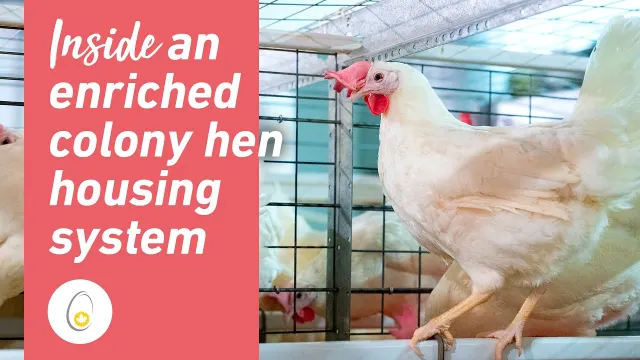 An inside look at an enriched hen housing systemEgg Farmers of Canada, 2 min
Quebec egg farmer shows the inside of an enriched colony hen housing system. Posted by the national egg farmers' body.
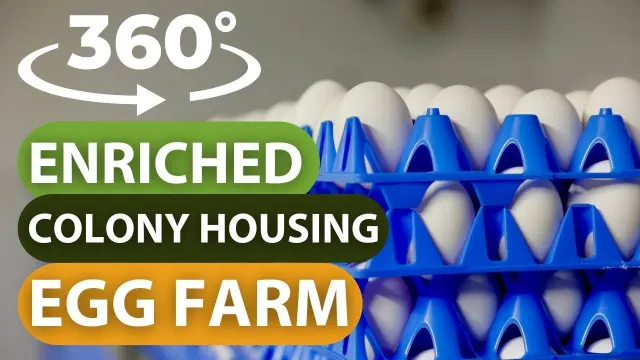 360 Enriched Colony Housing Egg FarmFarm & Food Care, 6 min
360-degree tour of an Ontario enriched colony egg barn: where hens live, how they are looked after.
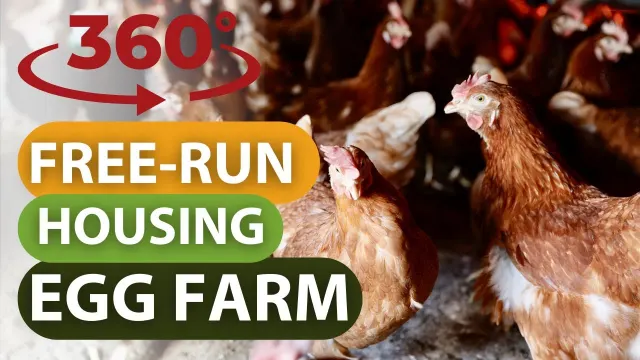 360 Free Run Housing Egg FarmFarm & Food Care, 5 min
360-degree tour of an Ontario free-run egg barn: perching, feeding, nesting, sleeping.
Sources
- NFACC Code of Practice, pullets and laying hens (2017, amended 2025)
- Egg Farmers of Canada, Animal Care Program on-farm requirements fact sheet (12 Feb 2025)
- Canadian General Standards Board, CAN/CGSB-32.310-2026 Organic production systems, general principles and management standards (March 2026; supersedes the 2020 edition with Corrigendum 1; clauses 6.6.4, 6.12.1, 6.13.1, 6.13.2, 6.13.6, 6.13.13)
- Health of Animals Regulations C.R.C. c. 296, Part XII Transport of Animals
- Safe Food for Canadians Regulations SOR/2018-108, Subdivision C Humane Treatment
- BC SPCA, Canadian organic standards 2015 (amended 2018) vs 2020, livestock (quotes clauses)
- Everything on Eggs
- How long do laying hens live?
- Do laying hens ever see their mother?
- Where do laying hens sleep and rest?
- How often are laying hens outside?
- Are laying hens' beaks trimmed?
- How long are laying hens transported?
- How are laying hens killed?
- Label: Legal minimum (federal law)
- Label: Egg Farmers of Canada Animal Care Program
- Label: Canada Organic
- Legal minimum (federal law) vs Canada Organic: Eggs