 How my food lives
Eggs · Outdoors
How often are laying hens outside?
Outdoor access is part of the laying life only, or not required. Furthest along: Canada Organic eggs, free range. Weakest: 5 standards, among them Legal minimum (federal law) and Egg Farmers of Canada, conventional cage.
Why it is like this
Free range under the Code gives access when the weather permits, with no day count. Organic hens must have outdoor access for one third of their laying life and may be kept in until peak lay. No rule in our data gives access on almost every day.
What the labels say
| Standard | Level |
|---|---|
| Legal minimum (federal law) | 1 Never. A bright barn is enough |
| Egg Farmers of Canada, conventional cage | 1 Never. A bright barn is enough |
| Egg Farmers of Canada, enriched cage | 1 Never. A bright barn is enough |
| Egg Farmers of Canada, free run | 1 Never. A bright barn is enough |
| Egg Farmers of Canada, free range | 1-3 level 1 guaranteed (Never. A bright barn is enough); up to level 3 depending on the farm |
| Canada Organic eggs, free range | 2-3 Outside only for one stage of its life: one third of the laying life |
How we read the levels
- Never. A bright barn is enough.
- Never, but it feels fresh air in the barn.
- On a few days a week.
- On almost every day.
Level 1: Never. A bright barn is enough.
Applies to: Legal minimum (federal law), Egg Farmers of Canada, conventional cage, Egg Farmers of Canada, enriched cage, Egg Farmers of Canada, free run and Egg Farmers of Canada, free range
Hens in cages and in free-run barns never go outside. Free range under the Code only says doors must exist, with access when the weather permits and no day or hour count. The Code gives no day count, so only Level 1 is sure for free range. Organic hens have their own text: outside for at least one third of the laying life.
Code section 2.7: free-range systems provide access to an outdoor area through doors or popholes, when the weather permits. Requirements (2.7.1) give door size (at least 35 cm high and 40 cm wide), fencing against ground predators and a way to restrict access when health is at risk; they set no minimum days or hours. Cage and free-run barn systems have no outdoor access. The Egg Farmers of Canada free range reading is between Level 1 and 3 because no frequency is written; we keep the lower level. CAN/CGSB-32.310 clause 6.13.2 a (CAN/CGSB-32.310-2026): layers may be confined during onset of lay, until peak production is reached, and the flock must have outdoor access for at least one third of its laying life. The guide places peak production around 28 to 30 weeks of age and says outdoor access is generally expected from May to September, depending on location. Outdoor areas must be vegetated with overhead cover (6.13.1 b). Enriched verandahs may replace the range in bad weather or disease risk (6.13.3). Enriched verandahs, a covered area with outdoor climate, are required for new barns, but existing barns may go without one until March 2031 (CAN/CGSB-32.310-2026, 6.13.3 c and e). Canada Organic reads between Level 2 and 3 and has its own text.
Level 2: Never, but it feels fresh air in the barn.
Possible on some farms, not guaranteed: Egg Farmers of Canada, free range
The hen lives in a barn with fresh air or daylight, but no rule gives her time outside.
No egg row in our Canada table sits at Level 2 alone. Canada Organic has an outdoor stage for at least one third of the laying life, so it sits between Level 2 and Level 3 and has its own text.
Level 3: On a few days a week.
Possible on some farms, not guaranteed: Egg Farmers of Canada, free range
No label we list sets a number of days outdoors for laying hens. A range season of about 120 days a year would be Level 3 on our scale.
Level 3 on our scale needs a stated outdoor season of about 120 days a year or more. The Egg Farmers of Canada free range rows do not give a day count that reaches it, so they read between Level 1 and 3 and the lower level counts. Canada Organic (clause 6.13.2 a) names a share of the laying life, not days, and has its own text.
Canada Organic eggs, free range: Level 2 to 3
Outside for one stage of its life
Outside only for one stage of its life: at least one third of the laying life, about 18 of 72 weeks. Before that the hen may be kept in the barn.
Canada Organic, CAN/CGSB-32.310-2026, 6.13.2 a: layers may be confined during onset of lay, until peak production, and the flock must have outdoor access for at least one third of its laying life. A hen is kept to about 72 weeks (BC Egg) and starts to lay at about 19 weeks, so one third of the laying life is about 18 weeks, about one quarter of the whole life. That puts the cell between Level 2 and Level 3. Measured against the laying life alone the share would be exactly one third. Enriched verandahs, a roofed area, may stand in for the range in bad weather or disease risk (6.13.3); existing barns may go without one until March 2031 (6.13.3 e).
What stays open
The Code makes outdoor access optional. No rule requires hens to go outside on a given number of days.
Videos
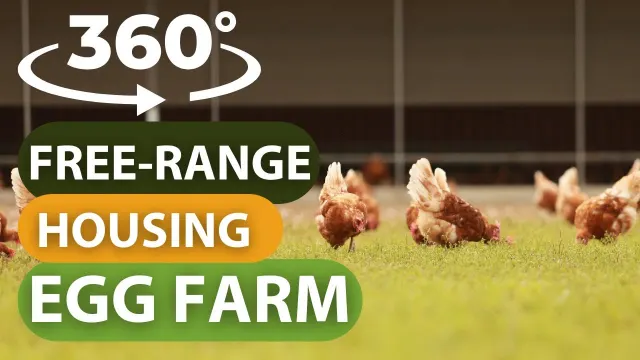 360 Free Range Housing Egg FarmFarm & Food Care, 6 min
360-degree tour of an Ontario free-range egg barn and how the hens get outside.
 What are the best eggs? Egg crackdown (CBC Marketplace)CBC News, 22 min
CBC Marketplace tests egg label claims and asks producers to show what the labels mean for the hens.
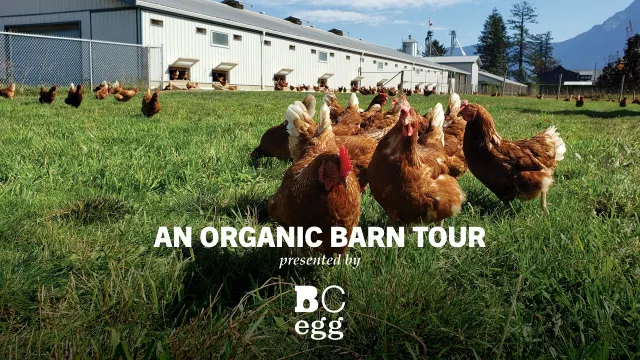 BC Egg, Organic Barn TourBC Egg, 3 min
Tour of a cage-free organic egg barn in Chilliwack, B.C. Posted by the provincial egg board.
Sources
- NFACC Code of Practice, pullets and laying hens (2017, amended 2025)
- Canadian General Standards Board, CAN/CGSB-32.310-2026 Organic production systems, general principles and management standards (March 2026; supersedes the 2020 edition with Corrigendum 1; clauses 6.6.4, 6.12.1, 6.13.1, 6.13.2, 6.13.6, 6.13.13)
- BC Egg, hen care page, end of the laying cycle at about 72 weeks (provincial industry figure)
- Health of Animals Regulations C.R.C. c. 296, Part XII Transport of Animals
- Safe Food for Canadians Regulations SOR/2018-108, Subdivision C Humane Treatment
- Canadian Organic Growers, guide to CAN/CGSB-32.310 clause 6 Livestock production (quotes the clauses of the 2020 edition)
- Everything on Eggs
- How long do laying hens live?
- Do laying hens ever see their mother?
- How much space does a laying hen have?
- Where do laying hens sleep and rest?
- Are laying hens' beaks trimmed?
- How long are laying hens transported?
- How are laying hens killed?
- Label: Legal minimum (federal law)
- Label: Egg Farmers of Canada Animal Care Program
- Label: Canada Organic
- Legal minimum (federal law) vs Canada Organic: Eggs