 How my food lives
Eggs · Resting place
Where do laying hens sleep and rest?
Litter on part of the floor is the best resting place we found. Level at the front: Egg Farmers of Canada, free run, Egg Farmers of Canada, free range and Canada Organic eggs, free range. Weakest: 3 standards, among them Legal minimum (federal law) and Egg Farmers of Canada, conventional cage.
Why it is like this
The Code requires litter on 15 to 33 per cent of the floor in barns, organic on at least 30 per cent solid floor. No rule in our data offers several soft, straw-covered places to choose from.
What the labels say
| Standard | Level |
|---|---|
| Legal minimum (federal law) | 1 A simple, dry, reasonably clean spot |
| Egg Farmers of Canada, conventional cage | 1 A simple, dry, reasonably clean spot |
| Egg Farmers of Canada, enriched cage | 1-2 level 1 guaranteed (A simple, dry, reasonably clean spot); up to level 2 depending on the farm |
| Egg Farmers of Canada, free run | 2 A dry, clean spot that does not press or chafe |
| Egg Farmers of Canada, free range | 2 A dry, clean spot that does not press or chafe |
| Canada Organic eggs, free range | 2 A dry, clean spot that does not press or chafe |
How we read the levels
- A simple, dry, reasonably clean spot.
- A dry, clean spot that does not press or chafe.
- A dry, soft spot with straw.
- Several dry, soft spots with straw, so it can choose.
Level 1: A simple, dry, reasonably clean spot.
Applies to: Legal minimum (federal law), Egg Farmers of Canada, conventional cage and Egg Farmers of Canada, enriched cage
In a conventional cage no litter is required. An enriched cage must add a nest, a perch and a small foraging surface, but the hen still lives in a cage.
Code 2.5.4 and 2.5.2 to 2.5.3: enriched cages need at least 31 cm² of flooring surface for foraging per hen (24.8 cm² in older cages), a nest space of 65 cm² per hen (40.6 cm² in older cages) and at least 15 cm of perch space per hen (11.2 cm in older cages, rising later). The Code does not say what the cage floor is made of in the parts we read. The enriched cage reading is between Level 1 and 2; we keep the lower level because the foraging surface is small and the floor type is not stated.
Level 2: A dry, clean spot that does not press or chafe.
Applies to: Egg Farmers of Canada, free run, Egg Farmers of Canada, free range and Canada Organic eggs, free range
Possible on some farms, not guaranteed: Egg Farmers of Canada, enriched cage
In cage-free barns the Code requires litter on part of the floor, at least 15 per cent in single-tier and 33 per cent in multi-tier systems. Organic needs 30 per cent solid floor.
Code 2.5.4 (final requirements): hens in litter-based systems must have continuous access to litter; single-tier systems at least 15 per cent of usable space as litter and one foraging site per 1,500 hens; multi-tier systems at least 33 per cent litter (15 per cent up to 24 weeks of age). Perches: at least 15 cm per hen, 20 per cent of it at least 40 cm high (2.5.3). Nests: 1 m² per 120 hens (2.5.2). Organic: litter required, minimum 30 per cent solid floor, 18 cm of perch per hen. The enriched cage reading is between Level 1 and 2 and the barn rows read 2. Level 2 is our reading: litter and perches, but no rule on several soft, straw-covered places to choose from.
What stays open
The Code requires litter in barns and perches and nests in enriched cages and barns. For conventional cages no litter is required.
Videos
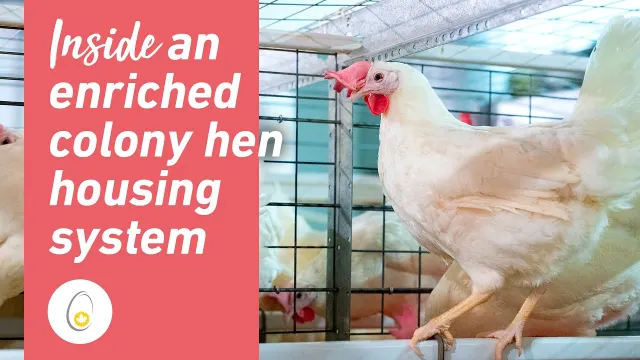 An inside look at an enriched hen housing systemEgg Farmers of Canada, 2 min
Quebec egg farmer shows the inside of an enriched colony hen housing system. Posted by the national egg farmers' body.
 360 Enriched Colony Housing Egg FarmFarm & Food Care, 6 min
360-degree tour of an Ontario enriched colony egg barn: where hens live, how they are looked after.
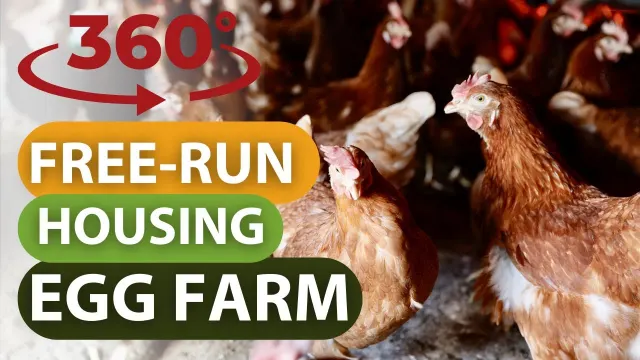 360 Free Run Housing Egg FarmFarm & Food Care, 5 min
360-degree tour of an Ontario free-run egg barn: perching, feeding, nesting, sleeping.
Sources
- NFACC Code of Practice, pullets and laying hens (2017, amended 2025)
- Canadian Organic Growers, guide to CAN/CGSB-32.310 clause 6 Livestock production (quotes the clauses of the 2020 edition)
- Health of Animals Regulations C.R.C. c. 296, Part XII Transport of Animals
- Safe Food for Canadians Regulations SOR/2018-108, Subdivision C Humane Treatment
- Canadian General Standards Board, CAN/CGSB-32.310-2026 Organic production systems, general principles and management standards (March 2026; supersedes the 2020 edition with Corrigendum 1; clauses 6.6.4, 6.12.1, 6.13.1, 6.13.2, 6.13.6, 6.13.13)
- Everything on Eggs
- How long do laying hens live?
- Do laying hens ever see their mother?
- How much space does a laying hen have?
- How often are laying hens outside?
- Are laying hens' beaks trimmed?
- How long are laying hens transported?
- How are laying hens killed?
- Label: Legal minimum (federal law)
- Label: Egg Farmers of Canada Animal Care Program
- Label: Canada Organic
- Legal minimum (federal law) vs Canada Organic: Eggs