 How my food lives
Beef · The final journey
How long are cattle transported to slaughter?
Within Austria slaughter cattle may travel 4.5 hours, with exceptions up to 8.5. Level at the front: 4 standards, among them Tierwohl verbessert (fattening cattle), Tierwohl kontrolliert 2 (fattening cattle) and Tierwohl kontrolliert 3 (fattening cattle, suckler cows). Weakest: 8 standards, among them Law (Animal Welfare Act, 1st Animal Husbandry Ordinance) and AMA-Gütesiegel (base, cattle keeping).
Why it is like this
The Animal Transport Act limits domestic slaughter transports to 4.5 hours, extendable to 8 or 8.5 hours. Tierwohl verbessert and Tierwohl kontrolliert 2 and 3 name at most four hours, Fair zum Tier! an abattoir at most 150 kilometres from the farm. Slaughter on the pasture without a trip for the live animal is regulated by none of the labels we read.
What the labels say
| Standard | Level |
|---|---|
| Law (Animal Welfare Act, 1st Animal Husbandry Ordinance) | 1-2 level 1 guaranteed (After a long journey, perhaps a whole day, at a large slaughterhouse); up to level 2 depending on the farm |
| AMA-Gütesiegel (base, cattle keeping) | 1-2 level 1 guaranteed (After a long journey, perhaps a whole day, at a large slaughterhouse); up to level 2 depending on the farm |
| AMA-Gütesiegel with module Weidehaltung (pasture keeping) | 1-2 level 1 guaranteed (After a long journey, perhaps a whole day, at a large slaughterhouse); up to level 2 depending on the farm |
| AMA-Gütesiegel with module Mehr Tierwohl (cattle) | 1-2 level 1 guaranteed (After a long journey, perhaps a whole day, at a large slaughterhouse); up to level 2 depending on the farm |
| Fair zum Tier! ALMO beef (REWE, BILLA) | 1-2 level 1 guaranteed (After a long journey, perhaps a whole day, at a large slaughterhouse); up to level 2 depending on the farm |
| Tierwohl verbessert (fattening cattle) | 3 After a short journey, at a slaughterhouse nearby |
| Tierwohl kontrolliert 2 (fattening cattle) | 3 After a short journey, at a slaughterhouse nearby |
| Tierwohl kontrolliert 3 (fattening cattle, suckler cows) | 3 After a short journey, at a slaughterhouse nearby |
| BIO AUSTRIA (cattle) | 1-2 level 1 guaranteed (After a long journey, perhaps a whole day, at a large slaughterhouse); up to level 2 depending on the farm |
| Prüf Nach! (Zurück zum Ursprung, cattle) | 3 After a short journey, at a slaughterhouse nearby |
| Demeter (cattle) | 1-2 level 1 guaranteed (After a long journey, perhaps a whole day, at a large slaughterhouse); up to level 2 depending on the farm |
| Organic (EU) | 1-2 level 1 guaranteed (After a long journey, perhaps a whole day, at a large slaughterhouse); up to level 2 depending on the farm |
How we read the levels
- After a long journey, perhaps a whole day, at a large slaughterhouse.
- After a journey of a few hours, at a slaughterhouse.
- After a short journey, at a slaughterhouse nearby.
- At home on the farm or pasture, with no journey.
Level 1: After a long journey, perhaps a whole day, at a large slaughterhouse.
Applies to: Law (Animal Welfare Act, 1st Animal Husbandry Ordinance), AMA-Gütesiegel (base, cattle keeping), AMA-Gütesiegel with module Weidehaltung (pasture keeping), AMA-Gütesiegel with module Mehr Tierwohl (cattle), Fair zum Tier! ALMO beef (REWE, BILLA), BIO AUSTRIA (cattle), Demeter (cattle) and Organic (EU)
Cattle may travel long in the EU, up to 29 hours in special vehicles with a one-hour break. That applies to trips abroad; for slaughter animals within Austria a shorter limit applies. The law, AMA (three rows), Fair zum Tier!, BIO AUSTRIA and Organic (EU) name no shorter hour limit and sit at 1 to 2.
Domestic slaughter transports in Austria are limited to 4.5 hours (Animal Transport Act 2007, section 18, subsection 1), extendable to 8 or 8.5 hours. The EU limit of 29 hours is in the EU transport regulation, which we did not reopen here. Breeding cattle are also exported to countries outside the EU. That concerns breeding cattle, not fattening bulls, but shows what is legally possible.
Level 2: After a journey of a few hours, at a slaughterhouse.
Possible on some farms, not guaranteed: Law (Animal Welfare Act, 1st Animal Husbandry Ordinance), AMA-Gütesiegel (base, cattle keeping), AMA-Gütesiegel with module Weidehaltung (pasture keeping), AMA-Gütesiegel with module Mehr Tierwohl (cattle), Fair zum Tier! ALMO beef (REWE, BILLA), BIO AUSTRIA (cattle), Demeter (cattle) and Organic (EU)
There is no row of its own at level 2. Within Austria slaughter animals may travel 4.5 hours, with exceptions up to 8 or 8.5 hours. That holds for the law, AMA-Gütesiegel, Fair zum Tier! and BIO AUSTRIA; the rows sit at 1 to 2.
Animal Transport Act 2007, section 18, subsection 1. The AMA cattle guideline and BIO AUSTRIA name no hours of their own for cattle.
Level 3: After a short journey, at a slaughterhouse nearby.
Applies to: Tierwohl verbessert (fattening cattle), Tierwohl kontrolliert 2 (fattening cattle), Tierwohl kontrolliert 3 (fattening cattle, suckler cows) and Prüf Nach! (Zurück zum Ursprung, cattle)
A short trip of at most four hours: Tierwohl verbessert, Tierwohl kontrolliert 2 and 3 require this. None names a distance limit; the hour limit alone counts as level 3. Prüf Nach! (HOFER's organic brand) also sets at most 4 hours of driving, for Bergrind and Weiderind (pn C.1 b, c).
Tierwohl verbessert, Tierwohl kontrolliert 2 and 3: a transport time of four hours is not exceeded (guidelines for fattening cattle, sections 7.1 and 6.1). Fair zum Tier! names 150 km to the slaughterhouse (section 3) but no hour figure. That is not an hour limit, so the row takes the law and sits at 1 to 2.
What stays open
AMA-Gütesiegel and BIO AUSTRIA name no hours for cattle. Usual: up to 4.5 hours within Austria, with exceptions up to 8.5.
Videos
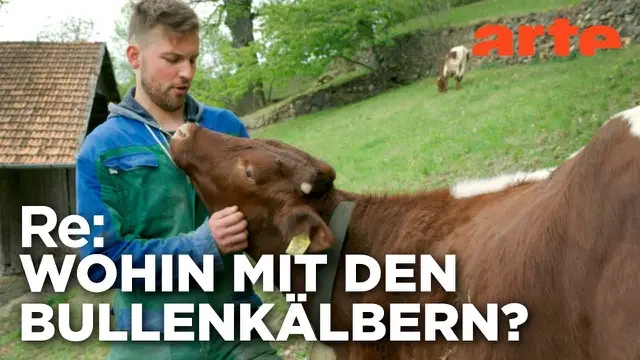 From discarded calf to saviour of the AlpsARTEde, 31 min
The report shows what happens to the male calves of dairy cows and how one farmer takes another route.
Note: this video shows images some people find distressing.
Animal suffering at the borders: the nightmare of an animal transport37 Grad (ZDF), 11 minA transport of in-calf cows is held at a border for weeks. The film shows suffering animals.
Note: this video shows images some people find distressing.
Animal transports: suffering on the high seasZDF, 21 minThe film shows how cattle and sheep from the EU are shipped to the Middle East and North Africa.
Sources
- Rung copied from the German table (there based on EU law, a label text or biology, partly without a source of its own; not re-checked for Austria)
- AMA-Gütesiegel guideline for cattle (calves, fattening, suckler cows), version 2021/1
- BIO AUSTRIA production guidelines, November 2025
- Gesellschaft !Zukunft Tierwohl!, guideline beef cattle "Tierwohl verbessert", version 4, 22 Jul 2026
- Prüf Nach! standard for products on the Austrian market, version 08/2025 (Werner Lampert Beratungsges.m.b.H.), the standard of HOFER's organic brand Zurück zum Ursprung, sections C.1 cattle, C.4 poultry and eggs, C.5 pigs
- Animal Transport Act 2007, section 18: domestic slaughter transports 4.5 hours, extendable to 8 or 8.5
- Gesellschaft !Zukunft Tierwohl!, guideline beef cattle "Tierwohl kontrolliert 2", version 3, 27 Jul 2026
- Gesellschaft !Zukunft Tierwohl!, guideline beef cattle "Tierwohl kontrolliert 3", version 3, 27 Jul 2026
- Fair zum Tier! criteria (long version), version 2026_L04, REWE International
- Everything on Beef
- How long do beef bulls live?
- How long do calves stay with their mother?
- How much space does a fattening bull have?
- What do beef cattle lie on?
- Do beef cattle get out to pasture?
- Are cattle dehorned?
- How are cattle slaughtered?
- Label: Legal minimum
- Label: AMA-Gütesiegel
- Label: Fair zum Tier!
- Label: Tierwohl verbessert
- Label: Tierwohl kontrolliert
- Label: BIO AUSTRIA
- Label: Prüf Nach!
- Label: Demeter
- Label: Organic (EU)
- BIO AUSTRIA vs Organic (EU): Beef
- AMA-Gütesiegel vs Organic (EU): Beef
- Tierwohl verbessert vs Tierwohl kontrolliert: Beef
- AMA-Gütesiegel vs Fair zum Tier!: Beef