 How my food lives
Beef · Physical interventions
Are cattle dehorned?
Dehorning is allowed, but only with sedation, local anaesthetic and pain relief. Furthest along: BIO AUSTRIA (cattle). Weakest: 11 standards, among them Law (Animal Welfare Act, 1st Animal Husbandry Ordinance) and AMA-Gütesiegel (base, cattle keeping).
Why it is like this
Horns are removed from calves under six weeks, by a trained person and with sedation, local anaesthesia and pain relief. Male cattle are castrated only after effective anaesthesia (Annex 2, point 2.8). No reason has to be given. Fair zum Tier! allows dehorning only in justifiable cases, BIO AUSTRIA only with permission from the authority, and Tierwohl kontrolliert 3 bans it for calves kept for young beef.
What the labels say
| Standard | Level |
|---|---|
| Law (Animal Welfare Act, 1st Animal Husbandry Ordinance) | 2 Only if the animals might otherwise injure themselves with them |
| AMA-Gütesiegel (base, cattle keeping) | 2 Only if the animals might otherwise injure themselves with them |
| AMA-Gütesiegel with module Weidehaltung (pasture keeping) | 2 Only if the animals might otherwise injure themselves with them |
| AMA-Gütesiegel with module Mehr Tierwohl (cattle) | 2 Only if the animals might otherwise injure themselves with them |
| Fair zum Tier! ALMO beef (REWE, BILLA) | 2 Only if the animals might otherwise injure themselves with them |
| Tierwohl verbessert (fattening cattle) | 2 Only if the animals might otherwise injure themselves with them |
| Tierwohl kontrolliert 2 (fattening cattle) | 2 Only if the animals might otherwise injure themselves with them |
| Tierwohl kontrolliert 3 (fattening cattle, suckler cows) | 2 Only if the animals might otherwise injure themselves with them |
| BIO AUSTRIA (cattle) | 2-3 level 2 guaranteed (Only if the animals might otherwise injure themselves with them); up to level 3 depending on the farm |
| Prüf Nach! (Zurück zum Ursprung, cattle) | 2 Only if the animals might otherwise injure themselves with them |
| Demeter (cattle) | 2 Only if the animals might otherwise injure themselves with them |
| Organic (EU) | 2 Only if the animals might otherwise injure themselves with them |
How we read the levels
- Always, if it makes keeping the animals easier.
- Only if the animals might otherwise injure themselves with them.
- Only if a particular animal needs treatment itself.
- Never. The animal keeps everything it was born with.
Level 2: Only if the animals might otherwise injure themselves with them.
Applies to: Law (Animal Welfare Act, 1st Animal Husbandry Ordinance), AMA-Gütesiegel (base, cattle keeping), AMA-Gütesiegel with module Weidehaltung (pasture keeping), AMA-Gütesiegel with module Mehr Tierwohl (cattle), Fair zum Tier! ALMO beef (REWE, BILLA), Tierwohl verbessert (fattening cattle), Tierwohl kontrolliert 2 (fattening cattle), Tierwohl kontrolliert 3 (fattening cattle, suckler cows), BIO AUSTRIA (cattle), Prüf Nach! (Zurück zum Ursprung, cattle), Demeter (cattle) and Organic (EU)
Horns are removed from calves under six weeks with sedation, local anaesthetic and pain relief, and castration is done under anaesthesia. That holds for the law, AMA-Gütesiegel, Fair zum Tier!, Tierwohl verbessert and Tierwohl kontrolliert 2 and 3. It is still routine.
First Animal Husbandry Ordinance, Annex 2, point 2.8: dehorning only with sedation, local anaesthesia and effective post-operative pain relief, for calves under six weeks by a trained person, otherwise by the vet. Castration of male cattle is allowed only after effective anaesthesia and post-operative pain treatment. Nobody has to give a reason. The German "without anaesthesia" does not apply here. Fair zum Tier! ALMO-Rind: dehorning only in justifiable cases, surgical castration under sedation and pain treatment (section 3). Tierwohl kontrolliert 3 bans dehorning but allows castration under anaesthesia by the vet, so the row counts at 2. The standard behind HOFER's organic brand: the Weiderind is not dehorned (pn C.1 c). For Weiderind and Bergrind, males are castrated only after effective sedation, local anaesthesia and extra pain relief (pn C.1 b, c). Castration stays routine, so the row sits at 2. Demeter bans dehorning, with an exception in specially justified cases. Calves may be castrated when it is needed for their health, welfare or hygiene (section 7.3.5.1). The organic rules apply to castration, so the row sits at 2.
Level 3: Only if a particular animal needs treatment itself.
Possible on some farms, not guaranteed: BIO AUSTRIA (cattle)
Only BIO AUSTRIA reaches this far, at 2 to 3: dehorning there needs an authority permit because of an operational need.
BIO AUSTRIA: dehorning needs an authority permit because of an operational need, with sedation, local anaesthesia and pain relief (3.2.4, 3.1.8.7). Tierwohl kontrolliert 3 bans dehorning (section 5.3) but allows castration of male calves under anaesthesia by the vet, up to the fifth month of life. The worst routine intervention that is allowed decides the level, so this row counts at 2 and not at 3.
What stays open
For AMA-Gütesiegel (cattle) the law applies: dehorning of calves under six weeks, with anaesthesia. Tierwohl verbessert bans dehorning in principle, with pasture farms exempt until 31 December 2027. Castration is done by the vet with anaesthesia and 48 hours of pain treatment (ztvr 5.3).
Videos
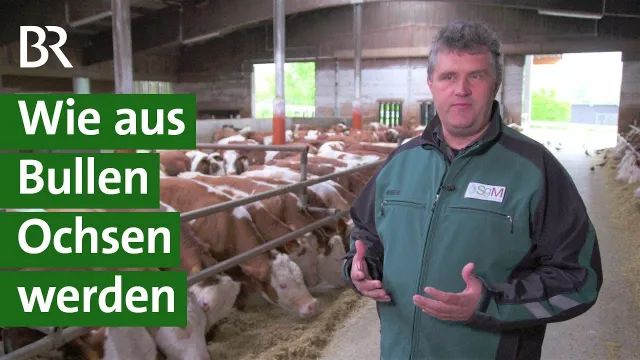 How young bulls become oxenUnser Land (BR), 7 min
The item shows the castration of young bulls that turns them into oxen. Set in Bavaria.
Sources
- Prüf Nach! standard for products on the Austrian market, version 08/2025 (Werner Lampert Beratungsges.m.b.H.), the standard of HOFER's organic brand Zurück zum Ursprung, sections C.1 cattle, C.4 poultry and eggs, C.5 pigs
- Demeter Austria, production and processing standard, valid from 1 Jan 2026, sections 7.3.5 to 7.3.10 (animal keeping, calf feeding, transport and slaughter)
- 1st Animal Husbandry Ordinance (Austria), annexes 2, 5, 6, legal database, version of 21 Nov 2026
- Fair zum Tier! criteria (long version), version 2026_L04, REWE International
- Gesellschaft !Zukunft Tierwohl!, guideline beef cattle "Tierwohl verbessert", version 4, 22 Jul 2026
- Gesellschaft !Zukunft Tierwohl!, guideline beef cattle "Tierwohl kontrolliert 2", version 3, 27 Jul 2026
- Gesellschaft !Zukunft Tierwohl!, guideline beef cattle "Tierwohl kontrolliert 3", version 3, 27 Jul 2026
- BIO AUSTRIA production guidelines, November 2025
- Rung copied from the German table (there based on EU law, a label text or biology, partly without a source of its own; not re-checked for Austria)
- Everything on Beef
- How long do beef bulls live?
- How long do calves stay with their mother?
- How much space does a fattening bull have?
- What do beef cattle lie on?
- Do beef cattle get out to pasture?
- How long are cattle transported to slaughter?
- How are cattle slaughtered?
- Label: Legal minimum
- Label: AMA-Gütesiegel
- Label: Fair zum Tier!
- Label: Tierwohl verbessert
- Label: Tierwohl kontrolliert
- Label: BIO AUSTRIA
- Label: Prüf Nach!
- Label: Demeter
- Label: Organic (EU)
- BIO AUSTRIA vs Organic (EU): Beef
- AMA-Gütesiegel vs Organic (EU): Beef
- Tierwohl verbessert vs Tierwohl kontrolliert: Beef
- AMA-Gütesiegel vs Fair zum Tier!: Beef