 How my food lives
Dairy · Lifespan
How long do dairy cows live?
Could live 15 to 25 years. Is slaughtered at about 4 to 6. The same for every label: The dairy cow is a grown animal when she is slaughtered, but not an old one.
Why it is like this
Spanish law sets no age. Cows that left the Holstein farms in CONAFE milk recording in 2022 had lived 1,983 days on average, a little under five and a half years. A small investigation of eleven farms in Asturias reports 4 to 6 years. Sources differ on how old a cow could get (15 to 20 years in most, up to 25 on the Spanish advocacy page). We found no official average from the ministry.
What the labels say
| Standard | Level |
|---|---|
| Conventional (legal minimum) | 2 |
| Welfair | 2 |
| Ecológico (EU organic) | 2 |
How we read the levels
- Until it is big enough to be used. It may still be very young.
- Until it is at least fully grown.
- Until it has lived half of its possible life.
- Until it is old.
- Until it dies of its own accord.
Level 2: Until it is at least fully grown.
The dairy cow is a grown animal when she is slaughtered, but not an old one. According to the Spanish Holstein federation (CONAFE), cows that left the farms in its milk recording in 2022 had lived 1,983 days on average, a little under five and a half years.
Spanish law sets no age, so conventional milk counts as a grown animal (RD 348/2000). Igualdad Animal, an animal advocacy group, reports 4 to 6 years on eleven farms in Asturias (Nov 2023 to Feb 2024, published 6 May 2025); this is a small sample, not a national statistic. A broader figure comes from CONAFE, the Holstein federation: cows that left the farms in its milk recording in 2022 had lived 1,983 days on average (2,167 in 2002). Leaving the herd also includes cows that die on the farm, so this is not exactly the age at slaughter. We found no official average from the ministry. How old a cow could get differs by source: 15 to 20 years in most, up to 25 on the Spanish advocacy page. Organic sets no longer life either (Reg 2018/848).
What stays open
At least the legal minimum applies: a grown animal. Welfair is in the table, at least at the legal values: it scores the animals' state, and we have not read its prerequisite checklist for this species.
Videos
Note: this video shows images some people find distressing.
Industrial livestock farming, animal welfare and the future of agricultureDW Documental, 32 minDW documentary with three views of intensive livestock farming, including a pig farmer who opens his barns.
Note: this video shows images some people find distressing.
Livestock farming under scrutiny: saving animals from the slaughterhouseDW Documental, 28 minDairy cows stop being profitable at about six years old; a German group tries to save some from slaughter.
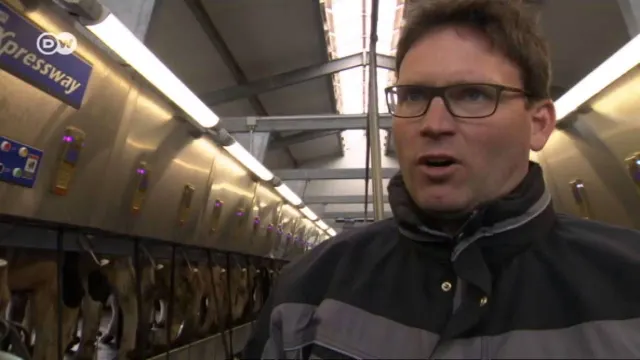 Super-producing cows and super-cheap milkDW Español, 5 min
Short report on a German farm with 800 dairy cows giving about 20,000 litres a year each.
Further reading
- Igualdad Animal: dairy industry in Spain, investigation (in Spanish) (Article, animal advocacy group)
- BOE: Real Decreto 348/2000, farm animals (in Spanish) (Legal text)
Sources
- Real Decreto 348/2000, farm animals in general (BOE)
- CONAFE (Spanish Holstein federation), Revista Frisona, 27 Mar 2023: lifetime production of cows that left herds in 2022
- Igualdad Animal: investigation of eleven dairy farms in Asturias, 6 May 2025 (animal advocacy group)
- Biology of the animals (Vier Pfoten, ProVieh, FishBase, FAO)
- Regulation (EU) 2018/848, organic production, Annex II (EUR-Lex)
- Welfair certification page (animalwelfair.com)
- Everything on Dairy
- Are calves separated from their mothers?
- How much room do dairy cows have?
- What do dairy cows lie on?
- Do dairy cows get to graze on pasture?
- Are dairy cows' horns removed?
- How long are cows transported?
- How are dairy cows slaughtered?
- Label: Legal minimum
- Label: Welfair
- Label: Organic (EU)
- Legal minimum vs Organic (EU): Dairy
- Legal minimum vs Welfair: Dairy
- Organic (EU) vs Welfair: Dairy