 How my food lives
Eggs · Freedom of movement
How much space does a laying hen have?
Usual: 750 square centimetres in a cage, or 9 hens on one square metre in a barn. Furthest along: Code 0, ecológico (EU organic). Weakest: 4 standards, among them Code 3, jaula (enriched cage) and Code 2, suelo (barn).
Why it is like this
In 2020, 77.6 percent of Spanish hens lived in enriched cages (MAPA census via ASEPRHU, not updated). A cage hen has 750 cm2, about one and a quarter sheets of A4 paper. In a barn 9 hens share one square metre. Free range adds one hen per 4 square metres outside, organic allows 6 hens per square metre indoors. Welfair publishes no density.
What the labels say
| Standard | Level |
|---|---|
| Code 3, jaula (enriched cage) | 1 Stand up and lie down again |
| Code 2, suelo (barn) | 1-2 level 1 guaranteed (Stand up and lie down again); up to level 2 depending on the farm |
| Code 1, campero (free range) | 1-2 level 1 guaranteed (Stand up and lie down again); up to level 2 depending on the farm |
| Welfair | 1 Stand up and lie down again |
| Code 0, ecológico (EU organic) | 3 Walk around without getting in anyone's way |
How we read the levels
- Stand up and lie down again.
- Turn around and stretch out its whole body.
- Walk around without getting in anyone's way.
- Run and play.
Level 1: Stand up and lie down again.
Applies to: Code 3, jaula (enriched cage), Code 2, suelo (barn), Code 1, campero (free range) and Welfair
In an enriched cage each hen has 750 square centimetres, about one and a quarter sheets of A4 paper. In a barn up to 9 hens share one square metre. Standing is possible, running is not.
Real Decreto 3/2002 Annex III: enriched cages give at least 750 cm2 of cage area per hen, 600 cm2 of it usable, with a perch of 15 cm, a nest and litter (Annex III 1). Barn (code 2) allows up to 9 hens per square metre of usable area (Annex IV point 4), so each hen has about 1,100 cm2, just under two sheets of A4. Conventional cages have been banned since 1 January 2012 (Art. 3.2). In 2020 about 77.6 percent of Spanish hens lived in cages, 13 percent in barns, 8 percent free-range and 1.4 percent organic (MAPA census via ASEPRHU, 2020, not updated).
Level 2: Turn around and stretch out its whole body.
Possible on some farms, not guaranteed: Code 2, suelo (barn) and Code 1, campero (free range)
Barn and free-range hens can walk a few steps: up to 9 hens share a square metre indoors, and free range adds one hen per 4 square metres outside.
Barn (code 2) allows up to 9 hens per square metre of usable area (Real Decreto 3/2002 Annex IV point 4). Free-range (code 1) has the same barn plus continuous daytime access to runs of at most 2,500 hens per hectare, which is one hen per 4 m2 (Reg 2023/2465 Annex II point 1 c).
Level 3: Walk around without getting in anyone's way.
Applies to: Code 0, ecológico (EU organic)
Organic hens have more room in the barn: at most 6 hens per square metre, and 4 square metres of run outside for each hen.
Reg 2020/464 Annex I Part IV point 3: 6 hens per square metre indoors, 18 cm of perch per hen, 7 hens per nest and 4 m2 outdoors per hen. Six hens per square metre with a run is level 3.
What stays open
At least the legal minimum applies: enriched cage at 750 square centimetres or barn at 9 hens per square metre. Welfair is in the table at the legal values: its public prerequisite checklist goes no further than the law on this question, and its score of the animals' state sets no value here.
Videos
 Better without cages: the animal welfare traffic lightObservatorio de Bienestar Animal, 48 s
Equalia, an animal advocacy group, presents a traffic-light rating of supermarkets and brands on cage policy.
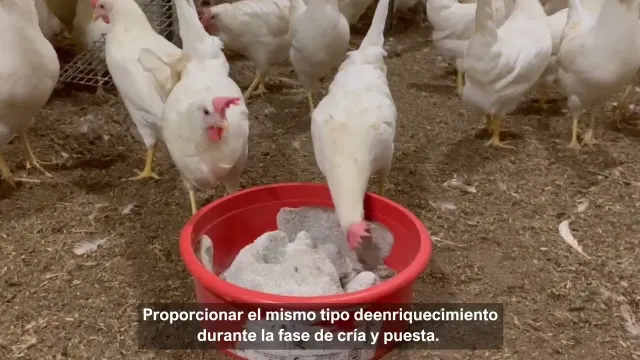 Best Practice Hens: enrichment and behaviour in alternative housingBest Practice Hens, 2 min
The EU project Best Practice Hens on why laying hens in cage-free systems should get regular environmental enrichment.
 What do the numbers printed on eggs mean?canalsur, 3 min
A nutritionist on Canal Sur explains the shell code: 0 organic, 1 free range, 2 barn, 3 cage.
Further reading
- BOE: Real Decreto 3/2002, laying hens (in Spanish) (Legal text)
- BOE: Real Decreto 1027/2024, egg marketing (in Spanish) (Legal text)
- ASEPRHU: the Spanish egg sector (in Spanish) (Sector page)
Sources
- Real Decreto 3/2002, laying hens (BOE)
- ASEPRHU: Spanish egg sector, MAPA census 2020 (aseprhu.es)
- Delegated Regulation (EU) 2023/2465, egg marketing standards, Annex II (EUR-Lex)
- Implementing Regulation (EU) 2020/464, organic stocking densities (EUR-Lex)
- Welfair prerequisite checklists (Anexo G): pigs M01/M02 of 01/08/2025 and laying hens M07 of 01/08/2025 (animalwelfair.com, PDF); minimum score 55 of 100 (Reglamento General v4.0 training slides)
- Welfair certification page (animalwelfair.com)
- Everything on Eggs
- How long do laying hens live?
- Do laying hens ever see their mother?
- Where do laying hens sleep and rest?
- How often are laying hens outside?
- Are laying hens' beaks trimmed?
- How long are laying hens transported?
- How are laying hens killed?
- Label: Legal minimum
- Label: Welfair
- Label: Organic (EU)
- Legal minimum vs Organic (EU): Eggs
- Legal minimum vs Welfair: Eggs
- Organic (EU) vs Welfair: Eggs