 How my food lives
Dairy · Outdoors
Do dairy cows get to graze on pasture?
Usual: no outdoor requirement. Furthest along: Animal Welfare Approved dairy. Weakest: 3 standards, among them Legal minimum (federal; no federal dairy welfare law) and Certified Humane dairy.
Why it is like this
A dairy cow does not have to go outside under federal law. Pasture was the main housing for milking cows on about 1 farm in 13 in 2014 (USDA NAHMS). USDA Organic requires daily grazing in the grazing season, and AWA continuous pasture access.
What the labels say
| Standard | Level |
|---|---|
| Legal minimum (federal; no federal dairy welfare law) | 1 Never. A bright barn is enough |
| USDA Organic milk (7 CFR 205) | 3-4 level 3 guaranteed (On a few days a week); up to level 4 depending on the farm |
| Certified Humane dairy | 1 Never. A bright barn is enough |
| Animal Welfare Approved dairy | 4 On almost every day |
| American Humane Certified dairy | 1 Never. A bright barn is enough |
| Regenerative Organic Certified dairy, Bronze | 3-4 level 3 guaranteed (On a few days a week); up to level 4 depending on the farm |
| Regenerative Organic Certified dairy, Silver | 3-4 level 3 guaranteed (On a few days a week); up to level 4 depending on the farm |
| Regenerative Organic Certified dairy, Gold | 3-4 level 3 guaranteed (On a few days a week); up to level 4 depending on the farm |
How we read the levels
- Never. A bright barn is enough.
- Never, but it feels fresh air in the barn.
- On a few days a week.
- On almost every day.
Level 1: Never. A bright barn is enough.
Applies to: Legal minimum (federal; no federal dairy welfare law), Certified Humane dairy and American Humane Certified dairy
A US dairy cow does not have to go outside. Certified Humane's base standard allows exercise areas of bare concrete for 4 hours a day, and American Humane does not require pasture. Pasture was the main housing on about 1 farm in 13 in 2014.
Certified Humane dairy E 22: exercise areas 4 hours a day, which may be bare concrete; E 23: loafing areas indoors or outdoors. Its continuous pasture rule (FW 27) belongs to the optional grass-fed section. American Humane dairy: pasture access not required. NAHMS Dairy 2014: pasture was the main housing for lactating cows on 7.5 percent of operations, an open or dry lot on 7.3 percent.
Level 3: On a few days a week.
Applies to: USDA Organic milk (7 CFR 205), Regenerative Organic Certified dairy, Bronze, Regenerative Organic Certified dairy, Silver and Regenerative Organic Certified dairy, Gold
USDA Organic cows graze every day of the grazing season and get at least 30 percent of their dry matter from pasture. At other times they need outdoor access, which a yard can provide.
USDA Organic 205.239(a)(1) and (a)(2): year-round outdoor access, daily grazing in the grazing season, continuous confinement prohibited; yards, feeding pads and feedlots may serve outside the grazing season. 205.240(b): an average of at least 30 percent of dry matter intake from pasture over the grazing season. Newborn calves may be kept off pasture for up to six months (205.239(c)(2)), and milking may take short periods each day. Regenerative Organic dairies also need USDA Organic. The rules are scored between levels 3 and 4 and we keep the lower; the length of the grazing season depends on the state and the farm.
Level 4: On almost every day.
Applies to: Animal Welfare Approved dairy
Possible on some farms, not guaranteed: USDA Organic milk (7 CFR 205), Regenerative Organic Certified dairy, Bronze, Regenerative Organic Certified dairy, Silver and Regenerative Organic Certified dairy, Gold
AWA cows have continuous access to outdoor pasture.
AWA dairy 7.0.1: continuous outdoor pasture access. It is the only row at this level.
What stays open
No outdoor rule is known for this standard.
Videos
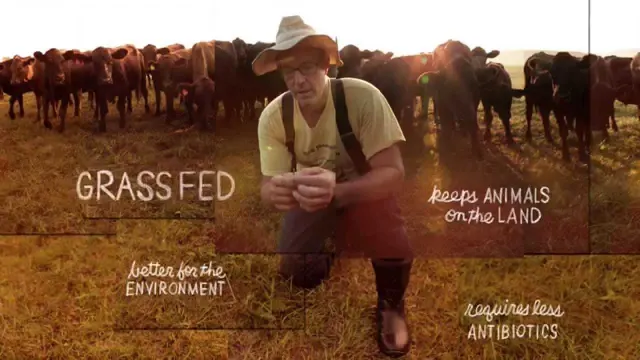 Grass Fed | The Lexicon of Sustainability | PBS FoodPBS Food, 3 min
A PBS Food short on what “grass-fed” means for cattle.
 Organic Sound and Sensible, What to Expect at an Organic Livestock Farm InspectionUSDA AMS, 52 min
A USDA Agricultural Marketing Service training film on what an organic livestock inspection covers. Long and technical, older video.
Sources
- Certified Humane (HFAC) Standards for Dairy Cattle, 2025 print
- American Humane Certified Dairy Cattle Standards, revision date February 2020 on the cover (file posted February 2025)
- USDA APHIS NAHMS: Trends in Dairy Cattle Health and Management Practices in the United States, 1991-2014 (Dairy 2014)
- 7 CFR 205.239 Mammalian and non-avian livestock living conditions (eCFR)
- 7 CFR 205.240 Pasture practice standard (eCFR)
- Regenerative Organic Certified Framework Guidance, Animal Welfare, v1.2, 4 December 2023
- AWA Dairy Cattle Standards 2026 v1
- Animal Welfare Act definitions, 7 USC 2132(g) (Cornell LII): 'animal' means warm-blooded animals and excludes livestock and poultry used for food or fiber; no federal rule on farm housing, space, outdoor access, weaning or alterations (no rule)
- Everything on Dairy
- How long do dairy cows live?
- Are calves separated from their mothers?
- How much room do dairy cows have?
- What do dairy cows lie on?
- Are dairy cows' horns removed?
- How long are cows transported?
- How are dairy cows slaughtered?
- Label: Legal minimum (federal law)
- Label: USDA Organic
- Label: Certified Humane
- Label: Animal Welfare Approved (AWA)
- Label: American Humane Certified
- Label: Regenerative Organic Certified (dairy)
- Legal minimum (federal law) vs USDA Organic: Dairy
- Legal minimum (federal law) vs Certified Humane: Dairy
- Legal minimum (federal law) vs Animal Welfare Approved (AWA): Dairy
- Legal minimum (federal law) vs American Humane Certified: Dairy