 How my food lives
Beef · Outdoors
Do beef cattle get out to pasture?
Usual: some time on grass, then an open feedlot at the end. Level at the front: 4 standards, among them Certified Humane beef, GAP Step 5 beef and GAP Step 5+ beef (whole life on one farm). Weakest: Legal minimum (federal; no federal cattle welfare law) and American Humane Certified beef.
Why it is like this
No federal rule sends cattle outdoors. US feedlots are open pens, so the animal sees the sky. USDA Organic requires daily grazing in the grazing season and allows finishing in a feedlot for up to one fifth of life or 120 days. GAP Steps 5 and 5+ and Animal Welfare Approved keep cattle on pasture all the time.
What the labels say
| Standard | Level |
|---|---|
| Legal minimum (federal; no federal cattle welfare law) | 1 Never. A bright barn is enough |
| USDA Organic beef (7 CFR 205) | 3-4 level 3 guaranteed (On a few days a week); up to level 4 depending on the farm |
| Certified Humane beef | 4 On almost every day |
| GAP Step 1 beef | 3 On a few days a week |
| GAP Step 2 beef | 3 On a few days a week |
| GAP Step 4 beef (there is no Step 3) | 3 On a few days a week |
| GAP Step 5 beef | 4 On almost every day |
| GAP Step 5+ beef (whole life on one farm) | 4 On almost every day |
| Animal Welfare Approved beef | 4 On almost every day |
| American Humane Certified beef | 1 Never. A bright barn is enough |
How we read the levels
- Never. A bright barn is enough.
- Never, but it feels fresh air in the barn.
- On a few days a week.
- On almost every day.
Level 1: Never. A bright barn is enough.
Applies to: Legal minimum (federal; no federal cattle welfare law) and American Humane Certified beef
No federal rule sends cattle outdoors.
We found no federal rule on outdoor access for cattle (absence in the texts read, not proof).
Level 3: On a few days a week.
Applies to: USDA Organic beef (7 CFR 205), GAP Step 1 beef, GAP Step 2 beef and GAP Step 4 beef (there is no Step 3)
USDA Organic and GAP Steps 1, 2 and 4 put cattle on pasture for most of their lives, with a time in a feedlot at the end.
7 CFR 205.239 and 205.240: daily grazing throughout the grazing season, at least 30 percent of dry matter intake from pasture, and slaughter stock may be finished in a feedlot for at most one fifth of life or 120 days, whichever is shorter. GAP Step 4: at least three quarters of life on pasture and no more than 4 months a year off it. The pasture days are fewer than every day of the year, so the lower level counts. GAP Steps 1 and 2: at least two thirds of life on range or pasture when seasonal conditions permit; removal for more than one third of the life is prohibited (7.1.1).
Level 4: On almost every day.
Applies to: Certified Humane beef, GAP Step 5 beef, GAP Step 5+ beef (whole life on one farm) and Animal Welfare Approved beef
Possible on some farms, not guaranteed: USDA Organic beef (7 CFR 205)
Certified Humane, GAP Steps 5 and 5+ and Animal Welfare Approved: cattle can go outside on almost every day.
Certified Humane E 1: beef cattle must be raised with continual access to the outdoors. That includes open feedyards, because the base standard allows them (E 21); the feedlot ban belongs to the optional grass-fed section. GAP Steps 5 and 5+: cattle live continuously on range or pasture. AWA 7.0.1: continuous outdoor pasture access, and 6.1.5 prohibits feedlots.
What stays open
There is no federal rule on outdoor access for cattle. Most beef cattle spend at least part of their lives on grass, and the last months in an open feedlot.
Videos
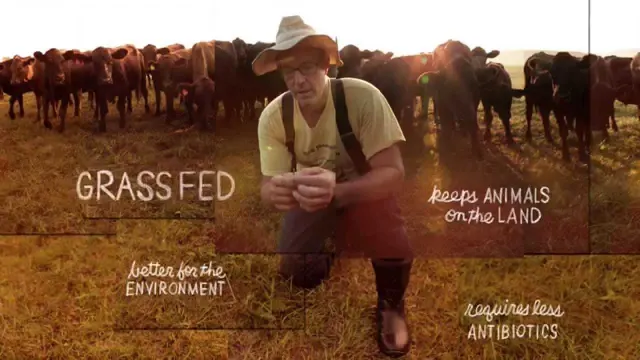 Grass Fed | The Lexicon of Sustainability | PBS FoodPBS Food, 3 min
A PBS Food short on what “grass-fed” means for cattle.
 Organic Sound and Sensible, What to Expect at an Organic Livestock Farm InspectionUSDA AMS, 52 min
A USDA Agricultural Marketing Service training film on what an organic livestock inspection covers. Long and technical, older video.
Further reading
- USDA ERS: Cattle and Beef, sector at a glance (Web page, USDA)
Sources
- 7 CFR 205.240 Pasture practice standard (eCFR)
- G.A.P. 5-Step Standards for Beef Cattle v1.2, 7 April 2022
- Certified Humane (HFAC) Standards for Beef Cattle, Edition 23, November 2025
- AWA Beef Cattle Standards 2026 v1
- Animal Welfare Act definitions, 7 USC 2132(g) (Cornell LII): 'animal' means warm-blooded animals and excludes livestock and poultry used for food or fiber; no federal rule on farm housing, space, outdoor access, weaning or alterations (no rule)
- 7 CFR 205.239 Mammalian and non-avian livestock living conditions (eCFR)
- USDA ERS, Cattle and Beef, Sector at a Glance
- Everything on Beef
- How long do beef bulls live?
- How long do calves stay with their mother?
- How much space does a fattening bull have?
- What do beef cattle lie on?
- Are cattle dehorned?
- How long are cattle transported to slaughter?
- How are cattle slaughtered?
- Label: Legal minimum (federal law)
- Label: USDA Organic
- Label: Certified Humane
- Label: Global Animal Partnership (GAP) 5-Step
- Label: Animal Welfare Approved (AWA)
- Label: American Humane Certified
- Legal minimum (federal law) vs USDA Organic: Beef
- Legal minimum (federal law) vs Certified Humane: Beef
- Legal minimum (federal law) vs Global Animal Partnership (GAP) 5-Step: Beef
- Legal minimum (federal law) vs Animal Welfare Approved (AWA): Beef