 How my food lives
Fish · Lifespan
How old are fish when they are killed for food?
Slaughtered as soon as the fish reaches eating size. No UK rule fixes an age. Level at the front: Wild-caught fish (no scheme) and MSC (wild-caught). Weakest: 4 standards, among them Legal minimum farmed fish (law in England) and RSPCA Assured salmon.
Why it is like this
The highest reported age is 13 years for Atlantic salmon and 11 for rainbow trout (FishBase). The page does not say whether these fish lived in the wild or in captivity, so it is an upper limit, not a usual value. According to the FAO, farmed rainbow trout of portion size are mostly 12 to 18 months old. We found no minimum slaughter age in any label or law we read. Wild-caught fish, with or without the MSC label, live in the wild until they are caught. They may be caught young or old, and no rule sets an age, so we place them between Level 1 and Level 4; the lower level counts.
What the labels say
| Standard | Level |
|---|---|
| Wild-caught fish (no scheme) | 1-4 level 1 guaranteed (Until it is big enough to be used. It may still be very young); up to level 4 depending on the farm |
| MSC (wild-caught) | 1-4 level 1 guaranteed (Until it is big enough to be used. It may still be very young); up to level 4 depending on the farm |
| Legal minimum farmed fish (law in England) | 1 Until it is big enough to be used. It may still be very young |
| RSPCA Assured salmon | 1 Until it is big enough to be used. It may still be very young |
| Organic salmon, GB regulation | 1 Until it is big enough to be used. It may still be very young |
| ASC (farmed salmon) | 1 Until it is big enough to be used. It may still be very young |
How we read the levels
- Until it is big enough to be used. It may still be very young.
- Until it is at least fully grown.
- Until it has lived half of its possible life.
- Until it is old.
- Until it dies of its own accord.
Level 1: Until it is big enough to be used. It may still be very young.
Applies to: Wild-caught fish (no scheme), MSC (wild-caught), Legal minimum farmed fish (law in England), RSPCA Assured salmon, Organic salmon, GB regulation and ASC (farmed salmon)
A fish is killed when it is caught or reaches eating size, and no law or label we read sets an age.
Fish are left out of the farm welfare regulations: 'farmed animal' excludes fish (reg 3(2)(a) of the 2007 Regulations). Several of the farmed salmon packs we priced are sold as Scottish, and the Scottish regulations leave fish out in the same way (reg 3(2)(a) of the 2010 Scottish Regulations), so the level is the same. No fish label we read sets a minimum age at slaughter. Where the law is silent the scale gives Level 1, and a label that adds nothing takes the legal level. Wild-caught fish, with or without the MSC label, live in the wild until they are caught. They may be caught young or old, and no rule sets an age, so we place them between Level 1 and Level 4 and the lower level counts. A wish for Level 2 or more is possible with wild fish, but not guaranteed.
Level 4: Until it is old.
Possible on some farms, not guaranteed: Wild-caught fish (no scheme) and MSC (wild-caught)
A long life is possible but not guaranteed: a wild fish lives in the wild until it is caught, it may be caught young or old, and no rule sets an age.
Wild-caught fish, with or without the MSC label, live in the sea, a lake or a river until they are caught. A catch may take young fish or old ones, and no law or label we read sets an age. That is why wild fish sit between Level 1 and Level 4, and the lower level counts. This level comes from the biology of the fish, not from a written rule.
What stays open
We found no fixed rule on the age at which a fish is slaughtered. No label or law we read sets a minimum age, for farmed or wild-caught fish.
Videos
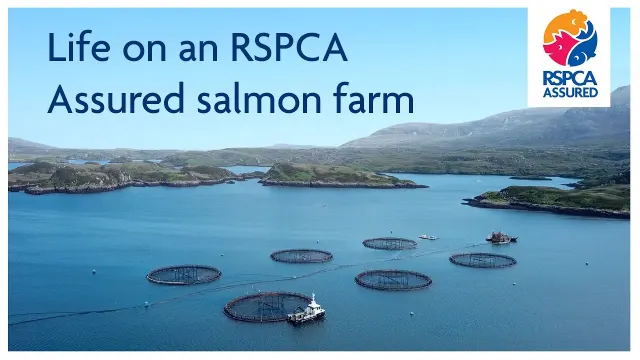 Life on an RSPCA Assured salmon farmRSPCA Assured
Visit to a salmon farm that follows the RSPCA Assured scheme, from the label body.
Sources
- Same Regs, reg 3 (reg 3(2)(a): fish, reptiles and amphibians are not 'farmed animals', so the Regulations do not apply to fish)
- Welfare of Farmed Animals (Scotland) Regulations 2010 (SSI 2010/388), reg 3(2)(a): fish are not farmed animals under these Regulations
- RSPCA welfare standards for farmed Atlantic salmon, May 2024
- ASC Salmon Standard v1.4, issued 5 September 2022, effective 1 February 2023 (https://peru.controlunion.com/wp-content/uploads/sites/5/2023/08/9__asc-salmon-standard-v1_4-final.pdf)
- Commission Reg (EC) 889/2008 as retained, Annex XIIIa (aquaculture stocking densities)
- Wild catch: the fish lives free in the sea, a lake or a river until it is caught. It may be caught young or old, and no rule sets an age. This level comes from the biology of the fish, not from a document
- Wild fish: the levels come from the biology of the fish, not from a written rule; the fish lives free in sea, lake or river until it is caught
- Source also used in the German table (not reopened for the UK): FishBase: Atlantic salmon, maximum reported age
- Source also used in the German table (not reopened for the UK): FishBase: rainbow trout, maximum reported age
- Source also used in the German table (not reopened for the UK): FAO: rainbow trout in aquaculture
- ASC Farm Standard V1.1 (ASC-STD-001), published 1 November 2026, effective 1 February 2027
- MSC Fisheries Standard version 3.1, web pages only (the standard PDF itself was not found)
- Everything on Fish
- Do farmed fish ever see their parents?
- How much space do farmed fish have?
- What does a farmed fish's habitat look like?
- Do farmed fish live outdoors?
- What treatments do farmed fish get?
- How long are live fish transported?
- How are fish killed?
- Label: Wild-caught fish
- Label: Legal minimum (law in England)
- Label: RSPCA Assured
- Label: GB organic regulation (other certifiers)
- Label: ASC (farmed salmon)
- Legal minimum (law in England) vs RSPCA Assured: Fish
- Legal minimum (law in England) vs GB organic regulation (other certifiers): Fish
- RSPCA Assured vs GB organic regulation (other certifiers): Fish