 How my food lives
Eggs · Outdoors
How often are laying hens outside?
Usual: no outdoors. Only free range, Svenskt Sigill and KRAV send hens out. Level at the front: Kod 1, frilandsägg (free range) and KRAV (kod 0, organic). Weakest: Kod 3, inredd bur (enriched cage) and Kod 2, frigående inomhus (barn).
Why it is like this
Cage and barn eggs come from hens that never go outside. Free range, Svenskt Sigill and KRAV give a run, with at least 4 square metres per hen at free range and KRAV. KRAV guarantees four summer months most of the day, and Sigill sets no number of days. Its checklist counts a veranda next to a run.
What the labels say
| Standard | Level |
|---|---|
| Kod 3, inredd bur (enriched cage) | 1 Never. A bright barn is enough |
| Kod 2, frigående inomhus (barn) | 1 Never. A bright barn is enough |
| Kod 1, frilandsägg (free range) | 3-4 level 3 guaranteed (On a few days a week); up to level 4 depending on the farm |
| Svenskt Sigill (IP Sigill Kyckling & Ägg 2026:1), layers | 2-4 level 2 guaranteed (Never, but it feels fresh air in the barn); up to level 4 depending on the farm |
| KRAV (kod 0, organic) | 3 On a few days a week |
How we read the levels
- Never. A bright barn is enough.
- Never, but it feels fresh air in the barn.
- On a few days a week.
- On almost every day.
Level 1: Never. A bright barn is enough.
Applies to: Kod 3, inredd bur (enriched cage) and Kod 2, frigående inomhus (barn)
In cages and in barn housing (egg code 3 and 2), a hen never goes outside. The barn is bright but closed.
Cages and barns have no outdoor duty (jv_poultry_care). The egg code system names them 'inredd bur' (3) and 'frigående inomhus' (2).
Level 2: Never, but it feels fresh air in the barn.
Applies to: Svenskt Sigill (IP Sigill Kyckling & Ägg 2026:1), layers
Svenskt Sigill eggs start at this rung. Sigill asks free access to an outdoor stay, but its checklist names verandas next to runs, so a covered veranda may be all a hen gets.
IP Sigill Kyckling & Ägg 2026:1 rule 4.8 S: laying hens have free access to an outdoor stay (utevistelse); a stay indoors is allowed only for a time, on an authority order, for example in an outbreak, or in extreme weather. Verification points (c) and (d) speak of 'verandor/rastgårdar' (verandas or runs), and the text does not say the area is open to the sky (sig_kyck). The scale rules of this site give a roofed run or winter garden rung 2 (ruling R15), so Sigill is shown as 2-4. KRAV does not count a veranda as outdoor time (5.5.1.3).
Level 3: On a few days a week.
Applies to: Kod 1, frilandsägg (free range) and KRAV (kod 0, organic)
Possible on some farms, not guaranteed: Svenskt Sigill (IP Sigill Kyckling & Ägg 2026:1), layers
With KRAV, hens go out most of the day for at least four summer months, and part of the day from spring to autumn. Free range (code 1) and Svenskt Sigill pass this rung on their way to rung 4.
Regulation 2023/2465 Annex II point 1: for free-range eggs, hens must have continuous daytime access to open-air runs, though access may be limited for a short time in the morning (r2465). Svenska Ägg: at least 4 m2 of run per hen (svagg_hona). Sigill rule 4.8 S: free access to outdoor areas, runs empty at least 6 weeks between flocks, protection by plants or a roof; no number of hours or days (sig_kyck). KRAV 5.5.1.3: outdoors most of the day for at least four consecutive months from May to September, part of the day from early spring to late autumn when weather allows, at least a third of life; a veranda does not replace the run; hens may be kept in at night. 5.5.1.4: outdoors at the latest 4 weeks after placement. The table shows KRAV at 3, free range at 3-4 and Svenskt Sigill at 2-4 (scale ruling R15). Whether hens go out depends on the run: without trees or shelter many stay in.
Level 4: On almost every day.
Possible on some farms, not guaranteed: Kod 1, frilandsägg (free range) and Svenskt Sigill (IP Sigill Kyckling & Ägg 2026:1), layers
Free range (code 1) and Svenskt Sigill reach this rung at their high end, because the hens may use the run every day of the year. Free range starts at 3, since the young hens grow up before they get a run; Sigill starts at 2, since a veranda may count.
Regulation 2023/2465 Annex II point 1: continuous daytime access to open-air runs for free-range hens (r2465). Sigill rule 4.8 S: free access, with stays indoors only on an authority order or in extreme weather (sig_kyck). The scale rules of this site give rung 4 to poultry with daily access all year, and 3-4 where access starts late in life (ruling R15). The free-range rules are written for laying hens, not for the young hens before they lay. KRAV guarantees only the warm half of the year and stays at 3.
Videos
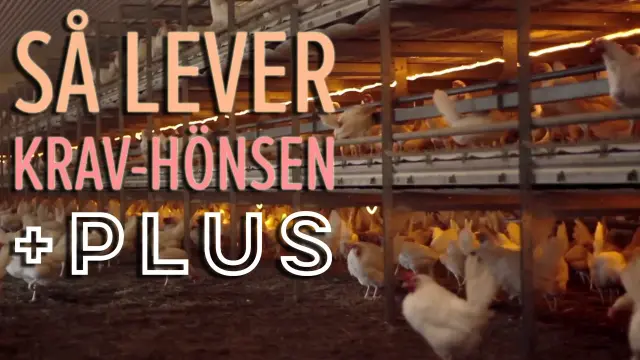 Organic eggs: how the hens liveSVT, 7 min
SVT's consumer programme Plus visits an organic egg farm and explains the egg code.
 Animal welfare in organic productionSLU Ekologisk produktion och konsumtion, 6 min
SLU researcher Torun Wallgren on how animal keeping differs between organic and conventional farms.
 Eco film 2: natural behaviour of the animalsEkologiska Lantbrukarna, 2 min
The organic farmers' association explains the organic principle of natural animal behaviour (KRAV farms).
Sources
- Jordbruksverket: Skötsel och stallmiljö för fjäderfän
- Delegated Regulation (EU) 2023/2465: egg marketing standard, Annex II
- Svenskt Sigill: IP Sigill Kyckling & Ägg 2026:1
- KRAV Regelbok 2026 (rules 5.4, 5.5, G4)
- Svenska Ägg: Om hönan (housing systems and densities)
- KRAV Regelbok 2026, rule 5.5.1.3 Tid för utevistelse
- KRAV Regelbok 2026, rule 5.5.1.4 Utevistelse efter insättning
- Everything on Eggs
- How long do laying hens live?
- Do laying hens ever see their mother?
- How much space does a laying hen have?
- Where do laying hens sleep and rest?
- Are laying hens' beaks trimmed?
- How long are laying hens transported?
- How are laying hens killed?
- Label: EU egg codes (cages, barn, free range)
- Label: Svenskt Sigill
- Label: KRAV
- Svenskt Sigill vs KRAV: Eggs