 How my food lives
Dairy · Mother and young
Are calves separated from their mothers?
In nature a calf drinks from its mother for 9 to 10 months. Here it can leave at 4 days. The same for every label: Nothing requires the calf to stay with its mother.
Why it is like this
A cow only gives milk after she has calved. The regulations treat a young calf, up to 14 days old, as one that has been separated from its mother, and allow it to leave the farm from 4 full days of age. Organic requires maternal or certified milk for at least 3 days, and recommends 3 months, but does not require the calf to stay with the cow. AsureQuality organic asks for three months of natural milk, which may come from other cows.
What the labels say
| Standard | Level |
|---|---|
| Legal minimum (Dairy Cattle Code 2019, Regulations 2018) | 1 |
| Certified organic (BioGro standard) | 1 |
| Certified organic (AsureQuality standard) | 1 |
How we read the levels
- Only briefly. It may be separated right after birth.
- A few weeks.
- Several months.
- Until the two part of their own accord.
Level 1: Only briefly. It may be separated right after birth.
Nothing requires the calf to stay with its mother. The regulations treat a young calf as one already separated from its mother, and it can leave the farm from 4 days. Organic (BioGro) sits here too, because it allows rearing on the mother but does not require it. AsureQuality organic sits here as well. Calves must get natural milk for three months, but it may be organic milk from other cows rather than from the mother (5.6.5), and our scale counts only time with the mother.
Regulation 3 (young calf) and regulation 33. BioGro requires maternal first milk, or certified first milk, for at least 3 days after birth, and maternal or certified milk of the species for the recommended period, which can be fed away from the cow.
What stays open
No rule keeps calf and cow together. Regulation 33 only fixes when a calf may leave the farm, from 4 full days of age.
Videos
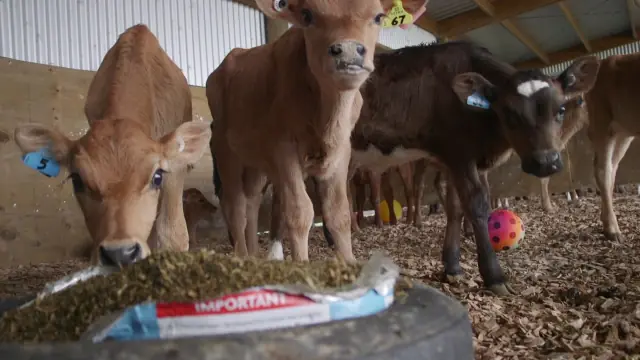 Setting up and maintaining the calf shedDairyNZ, 3 min
Industry body DairyNZ shows how a calf shed is set up and kept. Industry view.
 How to check a calf is fit for transportDairyNZ, 4 min
Industry body DairyNZ explains how farmers check that a calf is fit to travel. Industry view.
 Talking Dairy: Thriving after calving, key cow care and recovery tipsDairyNZ, 23 min
DairyNZ podcast episode on cow care and recovery after calving. Industry view.
Sources
- Everything on Dairy
- How long do dairy cows live?
- How much room do dairy cows have?
- What do dairy cows lie on?
- Do dairy cows get to graze on pasture?
- Are dairy cows' horns removed?
- How long are cows transported?
- How are dairy cows slaughtered?
- Label: Legal minimum and codes of welfare
- Label: BioGro certified organic
- Label: AsureQuality organic
- Legal minimum and codes of welfare vs BioGro certified organic: Dairy
- Legal minimum and codes of welfare vs AsureQuality organic: Dairy
- BioGro certified organic vs AsureQuality organic: Dairy