 How my food lives
Fish · Freedom of movement
How much space do farmed fish have?
Law: up to 25 kg of salmon or trout per cubic metre of water. Level at the front: Wild fish without label (cod, saithe and others) and MSC (wild fish). Weakest: Legal minimum for farmed fish and ASC Salmon Standard v1.4 (farmed salmon).
Why it is like this
At 25 kg per cubic metre about 2.5 percent of the water is fish, if a kilo of fish takes about a litre (our arithmetic). Organic rules hold salmon in sea net pens to 10 kg per cubic metre and trout in fresh water to 25 kg.
What the labels say
| Standard | Level |
|---|---|
| Wild fish without label (cod, saithe and others) | 4 Run and play |
| MSC (wild fish) | 4 Run and play |
| Legal minimum for farmed fish | 2 Turn around and stretch out its whole body |
| ASC Salmon Standard v1.4 (farmed salmon) | 2 Turn around and stretch out its whole body |
| Organic farmed fish (Debio, Ø-merket) | 3 Walk around without getting in anyone's way |
How we read the levels
- Stand up and lie down again.
- Turn around and stretch out its whole body.
- Walk around without getting in anyone's way.
- Run and play.
Level 2: Turn around and stretch out its whole body.
Applies to: Legal minimum for farmed fish and ASC Salmon Standard v1.4 (farmed salmon)
Law and ASC sit here: salmon and trout may be kept at up to 25 kg of fish per cubic metre of water in each production unit. About 2.5 percent of the water is then fish. ASC sets no figure of its own.
Akvakulturdriftsforskriften para 25: stocking density must be responsible and matched to water quality, behaviour, health and feeding technology. For broodstock and food fish of salmon and rainbow trout, the density per production unit may never exceed 25 kg/m3, except in slaughter pens and closed units. The volume the fish can move in is the base. At 25 kg per cubic metre about 2.5 percent of the water is fish if a kilo of fish takes about a litre (our arithmetic, not from the text). Para 19 asks for installations that give the fish good opportunity to move and show natural behaviour. Up to 25 kg/m3 is rung 2 on the scale. The ASC Salmon Standard v1.4 has no density figure that we found, so the ASC row follows the law.
Level 3: Walk around without getting in anyone's way.
Applies to: Organic farmed fish (Debio, Ø-merket)
Organic: salmon and trout in sea net pens are held to 10 kg per cubic metre, about 1 percent of the water. Norwegian organic fish is mostly salmon grown out in such pens.
Implementing Regulation 2020/464 Annex II: salmon, brown trout and rainbow trout in sea water 10 kg/m3 in net pens; salmon in fresh water 20 kg/m3; brown and rainbow trout in fresh water 25 kg/m3; cod and other gadids, sea bass and sea bream 15 kg/m3. A row is scored by the fish sold under it, and Norwegian organic fish is mostly salmon from sea net pens. Up to 20 kg/m3 is rung 3 on the scale. The annex also lists sturgeon with a higher figure, which is not a Norwegian product.
Level 4: Run and play.
Applies to: Wild fish without label (cod, saithe and others) and MSC (wild fish)
The open sea. A wild fish has all the space there is.
Wild fish without a label and with the MSC label live in the open sea until they are caught. This placement is carried over from the German table as a plain fact about wild fish. We opened no Norwegian text on it. The MSC Fisheries Standard v3.1 deals with fish stocks, the ecosystem and fishery management and adds nothing here.
What stays open
Every farmed row now has a rung here. ASC sets no density figure in standard v1.4, so the ASC row follows the legal 25 kg per cubic metre.
Videos
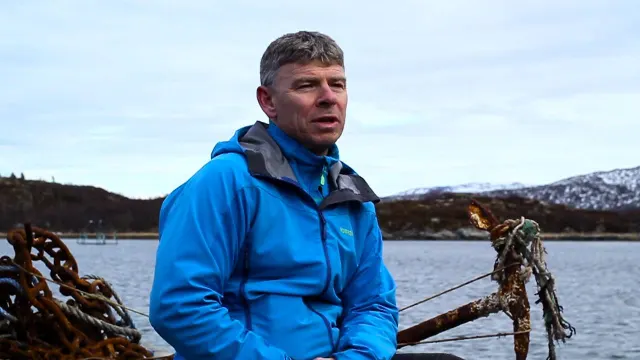 Debio film on organic salmonDebio Norge, 2 min
Film from Debio about organic salmon farming.
Further reading
Sources
- Product nature carried over from the German table (wild fish), not a written rule
- Akvakulturdriftsforskriften (FOR-2008-06-17-822)
- ASC Salmon Standard v1.4 (September 2022), principle 5
- Implementing Regulation (EU) 2020/464, organic detailed rules
- lovdata.no
- peru.controlunion.com
- publications.europa.eu
- Everything on Fish
- How old are fish when they are killed for food?
- Do farmed fish ever see their parents?
- What does a farmed fish's habitat look like?
- Do farmed fish live outdoors?
- What treatments do farmed fish get?
- How long are live fish transported?
- How are fish killed?
- Label: Wild fish without a label
- Label: MSC (wild fish)
- Label: Legal minimum
- Label: ASC (farmed fish)
- Label: Organic (Debio, EU)
- Legal minimum vs Organic (Debio, EU): Fish