 How my food lives
Eggs · Freedom of movement
How much space does a laying hen have?
Usual: up to nine hens on one square metre, or an enriched cage. Furthest along: Organic (Debio, Ø-merket). Weakest: Legal minimum for poultry and Frittgående (cage-free barn eggs).
Why it is like this
By law a hen needs 850 cm2 of cage area, a little more than one A4 sheet, or a barn with up to nine hens per square metre. Dyrevernmerket allows 8 hens per square metre, 9 with a winter garden and run all year. Organic allows 6. Only organic, at 6 hens per square metre with a run, gives a hen room to walk about without getting in the others' way.
What the labels say
| Standard | Level |
|---|---|
| Legal minimum for poultry | 1 Stand up and lie down again |
| Frittgående (cage-free barn eggs) | 1 Stand up and lie down again |
| Dyrevernmerket (eggs) | 2 Turn around and stretch out its whole body |
| Organic (Debio, Ø-merket) | 3 Walk around without getting in anyone's way |
How we read the levels
- Stand up and lie down again.
- Turn around and stretch out its whole body.
- Walk around without getting in anyone's way.
- Run and play.
Level 1: Stand up and lie down again.
Applies to: Legal minimum for poultry and Frittgående (cage-free barn eggs)
By law a Norwegian laying hen may live in an enriched cage with 850 cm2 of cage floor, or in a barn with up to nine hens on every square metre. Old-style bare cages are banned.
Poultry rules sec. 28 ban traditional cages. Sec. 29: furnished cages with at least 850 cm2 of cage area per hen, of which 675 cm2 usable, with nest, perch, litter bath and claw shortener. Sec. 25: loose-housing systems with at most nine hens per m2 usable area, at least one nest for every seventh hen and 15 cm of perch per hen. 850 cm2 is a little more than one A4 sheet (A4 is 623.7 cm2, our calculation). A cage stays legal, so only rung 1 is guaranteed by law.
Level 2: Turn around and stretch out its whole body.
Applies to: Dyrevernmerket (eggs)
At Dyrevernmerket the hens can turn round and stretch: at most 8 hens per square metre, 9 with a winter garden and run all year, and an aviary.
Dyrevernmerket's egg criteria 2.1.1: loose housing with aviary. 2.2.1: at most 8 hens per m2 usable indoor area. 2.2.2: up to 9 per m2 if the hens have routine access to a winter garden and run all year, with a winter garden of at least 20 % of the floor area. The scale puts 6 hens per m2 with a run at rung 3, so 8 or 9 hens stay at rung 2.
Level 3: Walk around without getting in anyone's way.
Applies to: Organic (Debio, Ø-merket)
In organic production at most 6 hens share a square metre indoors, and each hen has 4 m2 outdoors. With the run, that is room to walk about without getting in the others' way.
Implementing Regulation 2020/464 Annex I Part IV point 3: at most 6 laying hens per m2 usable indoor area, 4 m2 of outdoor area per hen, 7 hens per nest, 18 cm of perch per hen. Regulation 2018/848 Annex II Part II 1.9.4.4(d)-(e): open-air access. Six hens per m2 with a run is rung 3 on the scale.
Videos
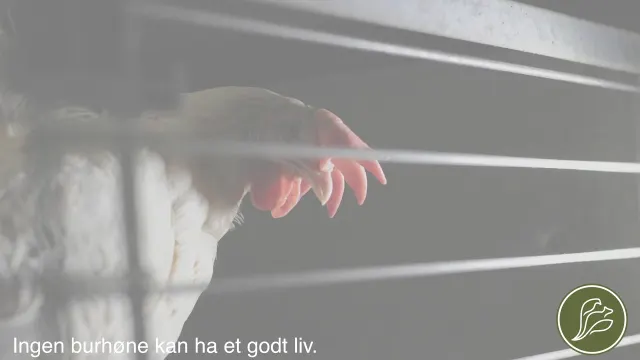 Egg production in NorwayDyrevernalliansen, 1 min
Short film by an animal welfare group about caged hens in Norway. The group says the industry gave it no access to film.
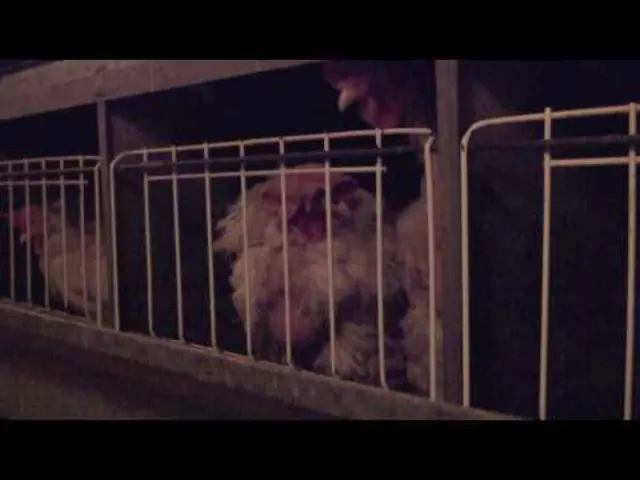 Caged hens in NorwayDyrevernalliansen, 1 min
Film from 2010 showing traditional cages, banned in 2012 and replaced by modified cages.
 Choose cage-free!Dyrevernalliansen, 1 min
Explains the difference between cage, free-range and organic for hens.
Further reading
Sources
- Everything on Eggs
- How long do laying hens live?
- Do laying hens ever see their mother?
- Where do laying hens sleep and rest?
- How often are laying hens outside?
- Are laying hens' beaks trimmed?
- How long are laying hens transported?
- How are laying hens killed?
- Label: Legal minimum
- Label: Frittgående (cage-free barn eggs)
- Label: Dyrevernmerket
- Label: Organic (Debio, EU)
- Legal minimum vs Dyrevernmerket: Eggs
- Legal minimum vs Organic (Debio, EU): Eggs
- Dyrevernmerket vs Organic (Debio, EU): Eggs