 How my food lives
Beef · Freedom of movement
How much space does a fattening bull have?
Law: loose housing, but tie stalls in old barns are allowed until 1 January 2034. Furthest along: Dyrevernmerket (dairy herds, meat from the same herd). Weakest: Legal minimum for cattle and Organic (Debio, Ø-merket).
Why it is like this
The cattle law sets no area for adult animals. Dyrevernmerket asks for loose housing for all and 5 m2 for an animal of 350 to 500 kg, a square of about 2.2 by 2.2 m. Organic gives 5 m2 indoors plus 3.7 m2 outdoors above 350 kg, but lets authorities allow tying on farms with up to 50 animals.
What the labels say
| Standard | Level |
|---|---|
| Legal minimum for cattle | 1 Stand up and lie down again |
| Dyrevernmerket (dairy herds, meat from the same herd) | 2 Turn around and stretch out its whole body |
| Organic (Debio, Ø-merket) | 1-3 level 1 guaranteed (Stand up and lie down again); up to level 3 depending on the farm |
How we read the levels
- Stand up and lie down again.
- Turn around and stretch out its whole body.
- Walk around without getting in anyone's way.
- Run and play.
Level 1: Stand up and lie down again.
Applies to: Legal minimum for cattle and Organic (Debio, Ø-merket)
Law: cattle are to be kept loose, but barns built before 22 April 2004 may keep tie stalls until 1 January 2034. No area per adult animal is set. Organic allows tying on farms up to 50 animals, so organic counts here at its low end.
Forskrift om hold av storfe para 7 sixth paragraph: cattle are housed loose, with the exceptions in para 32. Para 32 first paragraph: the duty starts on 1 January 2034 for animal rooms built before 22 April 2004 and used for cattle without a break since. Para 28 lets Mattilsynet depart from loose housing only when at least half of the herd are pure-bred conservation breeds. We found no square-metre figure for adult cattle in the forskrift, and para 23 sets areas for calves only. Organic: Regulation 2018/848 Annex II Part II 1.7.5 bans tethering but lets authorities allow it on farms with at most 50 animals (young stock not counted), with pasture in the grazing period and open air at least twice a week otherwise. The organic areas are bigger, 5 m2 indoors plus 3.7 m2 outdoors above 350 kg (Implementing Regulation 2020/464 Annex I Part I), which is rung 3. The tether exception sets the low end, so organic reads 1 to 3 and counts at rung 1.
Level 2: Turn around and stretch out its whole body.
Applies to: Dyrevernmerket (dairy herds, meat from the same herd)
Possible on some farms, not guaranteed: Organic (Debio, Ø-merket)
Dyrevernmerket: loose housing for every animal, no tying, and 5 m2 for an animal of 350 to 500 kg. It can turn around and stretch out, but walking about is not shown.
Dyrevernmerket dairy criteria 2.1.1: loose housing for all animals, whatever their sex or age. 2.1.2: no fixing or tying except for short periods in illness, treatment or identification. 2.5.2: free area per animal in a group pen is 1.5 m2 up to 100 kg, 2.5 m2 up to 200 kg, 4 m2 up to 350 kg, 5 m2 from 350 to 500 kg and 1 m2 per 100 kg above 500 kg. 5 m2 is a square of about 2.2 by 2.2 m. There is no outdoor area figure, which organic adds (3.7 m2 above 350 kg), so the guaranteed rung is 2.
Level 3: Walk around without getting in anyone's way.
Possible on some farms, not guaranteed: Organic (Debio, Ø-merket)
No row guarantees this rung. Organic reaches it at the upper end of its range, with 5 m2 indoors plus 3.7 m2 outdoors above 350 kg, but the tying exception holds the row lower.
Implementing Regulation 2020/464 Annex I Part I: 5 m2 indoors and 3.7 m2 outdoors for cattle above 350 kg. Regulation 2018/848 Annex II Part II 1.7.5: tethering allowed by the authority on farms with at most 50 animals.
Videos
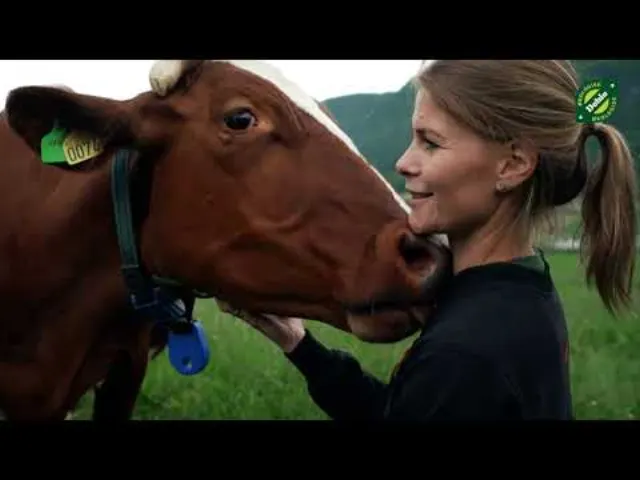 A mini-series on organic: ANIMAL WELFAREØkologisk Norge, 3 min
An organic farmer describes animal welfare for cows on her farm. From the organic farming organisation.
Further reading
- Dyrevernmerket, criteria for dairy cow production, milk and meat (Sep 2019) (Label criteria, PDF)
Sources
- Forskrift om hold av storfe (FOR-2004-04-22-665)
- Dyrevernmerket, criteria for dairy cow production, milk and meat (Sep 2019)
- Regulation (EU) 2018/848, organic production (Annex II)
- Implementing Regulation (EU) 2020/464, organic detailed rules
- lovdata.no
- publications.europa.eu
- publications.europa.eu
- dyrevernmerket.no
- Everything on Beef
- How long do beef bulls live?
- How long do calves stay with their mother?
- What do beef cattle lie on?
- Do beef cattle get out to pasture?
- Are cattle dehorned?
- How long are cattle transported to slaughter?
- How are cattle slaughtered?
- Label: Legal minimum
- Label: Dyrevernmerket
- Label: Organic (Debio, EU)
- Legal minimum vs Dyrevernmerket: Beef
- Legal minimum vs Organic (Debio, EU): Beef
- Dyrevernmerket vs Organic (Debio, EU): Beef