 How my food lives
Fish · Death
How are fish killed?
Wild fish mostly die in the net, and EU law sets no stunning duty for fish. Dutch law asks it only for eel. Level at the front: Farmed salmon without label (legal minimum, farmed in Norway), ASC farmed salmon (farmed in Norway) and EU organic leaf, farmed fish (Skal). Weakest: Wild fish without label and Wild fish with MSC.
Why it is like this
EU Regulation 1099/2009 gives fish only the general rule to spare avoidable pain. Dutch law adds one species: eel must be stunned before it is killed. Fishcount says most wild-caught fish are likely to die crushed in nets or from suffocation, probably over many minutes or hours. EU organic farms must stun fish, and so must salmon farms in Norway, where the salmon sold here comes from, with or without ASC. The stricter ASC rule, with a check of every stun, binds all ASC farms only from May 2028. The Good Fish Foundation rating covers sustainability and leaves fish welfare out.
What the labels say
| Standard | Level |
|---|---|
| Wild fish without label | 1 I don't care how it dies |
| Wild fish with MSC | 1 I don't care how it dies |
| Farmed salmon without label (legal minimum, farmed in Norway) | 2 It may feel brief fear or pain if it is quick |
| ASC farmed salmon (farmed in Norway) | 2 It may feel brief fear or pain if it is quick |
| EU organic leaf, farmed fish (Skal) | 2 It may feel brief fear or pain if it is quick |
How we read the levels
- I don't care how it dies.
- It may feel brief fear or pain if it is quick.
- It should feel no pain, even if it may be afraid beforehand.
- It should die without fear and without pain, and notice nothing of it.
Level 1: I don't care how it dies.
Applies to: Wild fish without label and Wild fish with MSC
Killed however is easiest. EU law gives fish only a general rule: spare them avoidable pain. It sets no stunning duty, so wild fish mostly die from being crushed in the net or by suffocation, over minutes or hours. Dutch law adds a stunning duty only for eel. The farmed salmon without a label sold here comes from Norway, where stunning is required (rung 2).
Regulation 1099/2009 Article 1(1): for fish only Article 3(1) applies. Fishcount: most wild-caught fish are likely to die crushed in nets or from suffocation, which probably takes many minutes or even hours. The Good Fish Foundation rating (VISwijzer) leaves fish welfare out. Fish farmed in the Netherlands without a label would be scored at this rung. Dutch law has one exception: eel must be stunned before it is killed (Besluit houders van dieren art. 5.11), which puts eel at rung 2. CBS counts 2,050 of the 7,320 t of Dutch farmed fish in 2024 as eel.
Level 2: It may feel brief fear or pain if it is quick.
Applies to: Farmed salmon without label (legal minimum, farmed in Norway), ASC farmed salmon (farmed in Norway) and EU organic leaf, farmed fish (Skal)
Stunned before killing, but fear before is possible: EU organic requires immediate unconsciousness, Dutch law requires eel to be stunned, and Norwegian law requires farmed fish to be stunned. Salmon from Norway sits here, with or without ASC: the stricter ASC rules bind all farms only from May 2028.
Regulation 2018/848 Annex II 3.1.6.9. A Dutch farm without a label has such a rule only for eel: Besluit houders van dieren art. 5.11, 'Alen worden voorafgaand aan het doden bedwelmd'. For other farmed fish we found none. Salmon farmed in Norway, with and without ASC: Akvakulturdriftsforskriften para 34 requires stunning before killing (as read for our Norway table). The ASC Farm Standard took effect on 1 August 2025, but it is mandatory for all audits only from 1 May 2028 (ASC version page, seen 22 November 2026). Until then a farm may still be audited against the older ASC Salmon Standard, in which our Norway reading found no stunning rule.
Videos
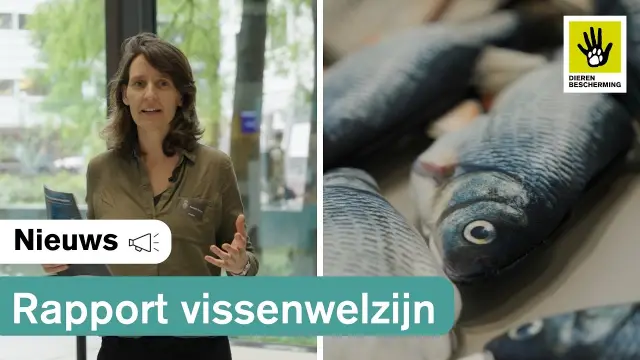 Towards animal-worthy fisheries and aquacultureDierenbescherming, 3 min
Presents a report on fishing and fish farming by the Dierenbescherming, CIWF Netherlands and the Dierencoalitie. From an advocacy group.
Further reading
- Fishcount: estimates of fish numbers (Research summary)
- EU Regulation 1099/2009, Article 1 (Legal text)
- Good Fish Foundation: method (in Dutch) (Rating method)
Sources
- Regulation (EC) No 1099/2009, Article 4(1) and 4(4) (stunning duty for mammals and birds); Article 1(1): for fish only Article 3(1) applies (spare avoidable pain, distress or suffering), so EU law has no stunning duty for fish
- Besluit houders van dieren (Wettenbank BWBR0035217), articles 1.6, 1.11, 1.20, 2.2 to 2.5, 2.12, 2.17, 2.28, 2.30-2.46, 2.50, 2.71, 5.1, 5.10 and 5.11
- Fishcount estimates (no welfare rule for killing wild-caught fish)
- Good Fish Foundation, method of the VISwijzer (sustainability only)
- CBS StatLine table 83622NED: Visserij en aquacultuur, hoeveelheid vis, schaal- en schelpdieren (annual 2024, final)
- Regulation (EU) 2018/848, Annex II Part II (livestock), original text
- Akvakulturdriftsforskriften (FOR-2008-06-17-822), Norwegian aquaculture regulation, paras 25, 31 and 34, as read for our Norway table
- Dyrevelferdsloven (LOV-2009-06-19-97), Norwegian animal welfare act, as read for our Norway table
- ASC Farm Standard V1.0.1A2 (August 2026), indicators 4.1.1.12, 4.1.3.2 to 4.1.3.6
- MSC Fisheries Standard v3.0 (no welfare rule for capture or killing)
- Everything on Fish
- How old are fish when they are killed for food?
- Do farmed fish ever see their parents?
- How much space do farmed fish have?
- What does a farmed fish's habitat look like?
- Do farmed fish live outdoors?
- What treatments do farmed fish get?
- How long are live fish transported?
- Label: Wild-caught fish without a label
- Label: MSC (wild-caught fish)
- Label: Legal minimum (law)
- Label: ASC (farmed fish)
- Label: EU organic (Skal)
- Legal minimum (law) vs EU organic (Skal): Fish