 How my food lives
Pork · Lifespan
How long do fattening pigs live?
Could live up to 15 years. No Canadian rule fixes the age at slaughter. The same for every label: No rule sets a slaughter age for a pig, so every row is at Level 1: the animal may be slaughtered young.
Why it is like this
A pig could live up to 15 years, a figure from sanctuary and animal welfare sources outside Canada; we found no Canadian source. In British Columbia it typically takes 5 to 6 months to raise a hog from birth to market weight, according to the BC Farm Industry Review Board. We found no minimum slaughter age in the pig Code, Certified Humane or Canada Organic documents.
What the labels say
| Standard | Level |
|---|---|
| Legal minimum (federal law) | 1 |
| PigCARE (Canadian Pork Excellence) | 1 |
| Certified Humane pork | 1 |
| Canada Organic pork | 1 |
How we read the levels
- Until it is big enough to be used. It may still be very young.
- Until it is at least fully grown.
- Until it has lived half of its possible life.
- Until it is old.
- Until it dies of its own accord.
Level 1: Until it is big enough to be used. It may still be very young.
No rule sets a slaughter age for a pig, so every row is at Level 1: the animal may be slaughtered young. In British Columbia it takes 5 to 6 months to raise a hog from birth to market weight.
Neither the federal rules nor the pig Code or the pork labels we read set a minimum age. The B.C. Farm Industry Review Board says it typically takes 5 to 6 months to raise a hog from birth to market weight. That is a provincial figure, not a rule. Level 1 is our reading of a silent rule.
What stays open
We found no fixed rule on the age at which a pig is slaughtered. Neither the federal rules nor the pig Code or the pork labels we read set a minimum age. In British Columbia it typically takes 5 to 6 months to raise a hog from birth to market weight (BC Farm Industry Review Board).
Videos
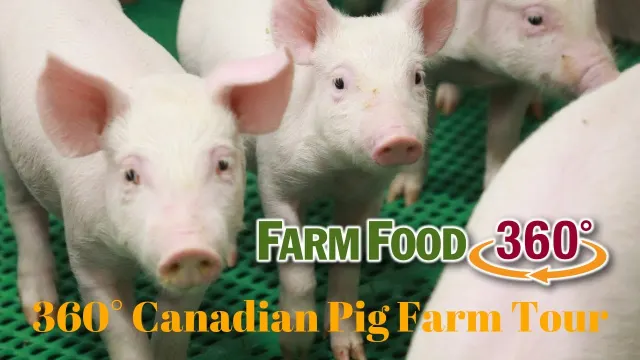 360° Canadian Pig Farm TourFarm & Food Care, 10 min
360-degree tour of a Canadian pig farm: housing, feed, enrichment.
 The Importance of NFACCNational Farm Animal Care, 2 min
The national farm animal care council explains what it does and how the Codes of Practice are made.
 The Truth About Farmed Animal Protection in Canada 🐷Animal Justice, 87 s
Short explainer on how farmed animals are protected, and not protected, by Canadian law. From an advocacy group.
Sources
- NFACC Code of Practice, pigs (2014)
- Humane Farm Animal Care (Certified Humane), standards for pigs
- Canadian Organic Growers, guide to CAN/CGSB-32.310 clause 6 Livestock production (quotes the clauses of the 2020 edition)
- B.C. Farm Industry Review Board, B.C. Hog Industry 2021 snapshot (official PDF, archived copy)
- Health of Animals Regulations C.R.C. c. 296, Part XII Transport of Animals
- Safe Food for Canadians Regulations SOR/2018-108, Subdivision C Humane Treatment
- Canadian General Standards Board, CAN/CGSB-32.310-2026 Organic production systems, general principles and management standards (March 2026; supersedes the 2020 edition with Corrigendum 1; clauses 6.6.4, 6.12.1, 6.13.1, 6.13.2, 6.13.6, 6.13.13)
- Natural lifespan figures from animal sanctuary and welfare sources outside Canada
- Everything on Pork
- How long do piglets stay with the sow?
- How much space does a fattening pig have?
- What do pigs lie on in the barn?
- Do pigs go outside?
- Are pigs' tails docked?
- How long are pigs transported?
- How are pigs slaughtered?
- Label: Legal minimum (federal law)
- Label: Canadian Pork Excellence PigCARE
- Label: Certified Humane (pork)
- Label: Canada Organic
- Legal minimum (federal law) vs Canada Organic: Pork